CFA Exam Preparation for Level I, Level II and Level III
Prepare for the CFA Program with expert teaching, Kaplan Schweser study resources, 4,000+ practice and revision questions, mock exams, recordings and structured support.
The CFA Program is administered by CFA Institute. EduDelphi provides the course, teaching and preparation support; CFA Institute controls registration, examinations, membership and award of the CFA charter.

What You Get with EduDelphi CFA Preparation
A complete learning system for understanding the curriculum, applying it to questions and preparing for exam conditions.
100+ guided hours per level
Build the full curriculum through structured, faculty-led sessions for your selected level.
Kaplan Schweser resources
Use recognised CFA review resources alongside EduDelphi teaching and revision support.
4,000+ questions
Practise topic questions, revision questions, item sets and level-appropriate exam tasks.
Mock exams and analysis
Complete timed mocks, review mistakes and focus revision on the areas that need work.
Recordings and LMS access
Return to classes, notes, mind maps and revision resources around work commitments.
Direct faculty support
Ask questions, review difficult topics and understand why one answer is stronger than another.
What Do You Need to Complete the CFA Program?
Training, exam registration, programme requirements and the charter are separate. This table makes the route clear.
| Item | Required? | Provider |
|---|---|---|
| EduDelphi CFA preparation | No, this is an optional preparation route | EduDelphi |
| CFA Program registration and examinations | Yes, for the relevant level | CFA Institute |
| Kaplan Schweser study resources | Optional review resources, included where confirmed in your EduDelphi package | Kaplan Schweser / EduDelphi package |
| Practical Skills Module | Yes, one at each level before results are released | CFA Institute |
| Qualifying work experience, membership and references | Required to become a CFA charterholder | CFA Institute |
Who Should Take the CFA Course in Oman?
Build deeper capability in analysis, valuation and investment decisions.
Strengthen portfolio, product, risk and client-advisory knowledge.
Develop stronger financial analysis, corporate finance and valuation skills.
Connect markets, instruments, portfolio risk and investment strategy.
Create a structured foundation for investment and analytical career paths.
Move toward investment analysis, portfolio, wealth or research roles.
Choose the CFA Level You Are Preparing For
Each level tests a different stage of knowledge and application. EduDelphi provides complete preparation across all three.
CFA Level I Course
Build broad knowledge across ethics, quantitative methods, economics, financial statement analysis, corporate issuers, equity, fixed income, derivatives, alternatives and portfolio management.
Exam focus: foundational knowledge, concepts and application through multiple-choice questions.
CFA Level II Course
Apply valuation and analytical frameworks to detailed vignettes across financial reporting, equity, fixed income, derivatives, portfolio construction and other curriculum areas.
Exam focus: analysis and application through item-set questions.
CFA Level III Course
Develop portfolio and wealth-management judgement through common curriculum content and your selected pathway: Portfolio Management, Private Markets or Private Wealth.
Exam focus: item sets and constructed-response tasks.
Prepare for the Correct CFA Exam Year
CFA curriculum and exam guidance can change by testing year. EduDelphi aligns teaching and Kaplan resources to the examination year selected by the candidate.
Exam-year terminology matters: CFA Institute has updated some topic names for 2027. The syllabus tables below intentionally use 2026 curriculum terminology. Official reference: CFA Program curriculum and 2027 curriculum update.

Current CFA Level I, II and III Curriculum Structure
Topic weights can change by exam year. The tables below provide the active 2026 structure used for preparation planning.
CFA Level I syllabus and topic weights
| Topic | 2026 weight | Preparation focus |
|---|---|---|
| Ethical and Professional Standards | 15-20% | Code, Standards and ethical application. |
| Quantitative Methods | 6-9% | Time value, statistics, probability and analytical tools. |
| Economics | 6-9% | Microeconomics, macroeconomics, currency and market forces. |
| Financial Statement Analysis | 11-14% | Statements, reporting quality, ratios and analysis. |
| Corporate Issuers | 6-9% | Governance, capital allocation and business decisions. |
| Equity Investments | 11-14% | Markets, securities, industries and valuation foundations. |
| Fixed Income | 11-14% | Debt securities, yields, valuation and risk. |
| Derivatives | 5-8% | Forwards, futures, options and swaps. |
| Alternative Investments | 7-10% | Real assets, private capital and alternative structures. |
| Portfolio Management | 8-12% | Risk, return, portfolio foundations and investor needs. |
CFA Level II syllabus and topic weights
| Topic | 2026 weight | Preparation focus |
|---|---|---|
| Ethical and Professional Standards | 10-15% | Ethics applied to complex professional situations. |
| Quantitative Methods | 5-10% | Advanced analytical models and interpretation. |
| Economics | 5-10% | Economic analysis for valuation and markets. |
| Financial Statement Analysis | 10-15% | Advanced reporting, quality and valuation adjustments. |
| Corporate Issuers | 5-10% | Capital structure, governance and corporate decisions. |
| Equity Investments | 10-15% | Company, industry and equity valuation. |
| Fixed Income | 10-15% | Term structure, credit, valuation and portfolio risk. |
| Derivatives | 5-10% | Valuation and application of derivative instruments. |
| Alternative Investments | 5-10% | Private capital, real estate and alternative valuation. |
| Portfolio Management | 10-15% | Portfolio construction, risk and investment application. |
CFA Level III syllabus and topic weights
| Content area | 2026 weight | Preparation focus |
|---|---|---|
| Asset Allocation | 15-20% | Strategic and tactical allocation decisions. |
| Portfolio Construction | 15-20% | Building portfolios around objectives and constraints. |
| Performance Measurement | 5-10% | Evaluation, attribution and manager assessment. |
| Derivatives and Risk Management | 10-15% | Risk tools and portfolio applications. |
| Ethical and Professional Standards | 10-15% | Ethical judgement in investment practice. |
| Selected pathway | 30-35% | Portfolio Management, Private Markets or Private Wealth. |
Source: CFA Institute curriculum and topic guidance. Always confirm the page for your testing year.
How the CFA Exams Are Structured
| Level | Current format | Testing time | Main skill tested |
|---|---|---|---|
| Level I | 180 multiple-choice questions | Two sessions of 135 minutes | Knowledge and application |
| Level II | 22 item sets with 88 multiple-choice questions; two sets are unscored trial items | Two sessions of 132 minutes | Analysis and valuation |
| Level III | 11 item sets and 11 constructed-response sets; two sets are unscored trial items | Two sessions of 132 minutes | Integration and portfolio judgement |
| Exam window | Level I | Level II | Level III |
|---|---|---|---|
| February | Available | Available | Not normally offered |
| May | Available | Not normally offered | Available |
| August | Available | Available | Available |
| November | Available | Available | Not normally offered |
No penalty for wrong answers
Answer every question. CFA Institute does not apply negative marking for incorrect answers.
English-language examination
The CFA Program examination is administered in English.
Computer-based testing
Appointments are delivered through the official test-centre network. Check live Oman availability before finalising travel.
Exam windows and seats can change. Confirm the dates, deadlines and appointment availability for your chosen level directly with CFA Institute before registering.
Choose the Right Level III Pathway
Level III includes common portfolio-management content and one selected pathway. The pathway represents roughly 30-35% of the exam and cannot be changed after registration.
For candidates focused on institutional portfolio construction, asset allocation, manager selection and portfolio decisions.
For candidates focused on private equity, private credit, real assets and private-market investment practice.
For candidates focused on individual and family wealth, planning, constraints and advisory decisions.
Official reference: CFA Level III specialised pathways.
Complete One Practical Skills Module at Every CFA Level
A Practical Skills Module is required at each level before CFA Institute releases the candidate’s result. Modules normally take around 10-20 hours and vary by level and exam year.
Level I
2026 options include Financial Modeling and Python Programming Fundamentals.
Level II
2026 options include Python Programming Fundamentals, Python, Data Science and AI, and Analyst Skills.
Level III
Portfolio Development and Construction plus pathway-aligned options: Practical Macro, Due Diligence or Managing Private Wealth Clients.
Official reference: CFA Practical Skills Modules.
CFA Program Entry Requirements
Candidates must meet CFA Institute’s current registration requirements. The route depends on education and work experience.
| Starting profile | Current route |
|---|---|
| Bachelor’s degree or equivalent | May register subject to current CFA Institute requirements. |
| Undergraduate student | For Level I, the examination window may be within 23 months of graduation. To sit Level II, the examination window must be within 11 months of graduation. |
| Work experience and/or higher education | A combined 4,000 hours over at least three sequential years may provide an alternative route, subject to current policy. |
| Level III candidate | A bachelor’s degree must be completed, or the candidate must meet CFA Institute’s qualifying work-experience route. |
For a complete explanation of candidate eligibility, the three exam levels, work-experience requirements and the distinction between passing the exams and earning the charter, read our CFA Program eligibility and career-path guide.
Official reference: CFA Program policies.
Passing the Exams Is One Part of the CFA Charter
Meet entry requirements
Confirm that you qualify to register for the CFA Program.
Pass all three levels
Complete Level I, Level II and Level III examinations.
Complete each PSM
Finish the required Practical Skills Module at every level.
Complete the charter process
Meet the 4,000-hour experience requirement over at least 36 months, then apply for membership and submit two references if one is an active member of the local society, or three professional references otherwise.
Official reference: How to earn the CFA charter.
Build Your Preparation in Three Stages
CFA Institute describes successful candidates as investing more than 300 hours per level on average. Your plan should combine teaching, reading, questions, revision and mocks.
1. Learn the curriculum
Complete faculty teaching and primary study resources. Build connected understanding before rushing into large question volumes.
2. Practise by topic
Apply each concept through questions. Review every mistake and return to weaker areas until reasoning becomes consistent.
3. Complete mocks and final revision
Use timed mocks, performance analysis, formula review and exam strategy to prepare for the real testing experience.

Recordings, Questions, Mocks and Focused Revision
Our CFA learning system brings teaching, practice and revision together. It supports candidates across Level I, Level II and Level III.
- Class recording library
- Topic and level progress
- Question accuracy and weak areas
- Mock-score history
- Item-set and constructed-response support
- Mind maps and concise notes
- Formula and revision resources
- EduDelphi study strategies
- Exam strategy and timed practice
- Direct faculty clarification
The strongest difference is not a generic technology claim. It is the combination of structured resources, measurable practice and faculty members candidates can speak with.
Learn with Experienced Finance and Investment Faculty
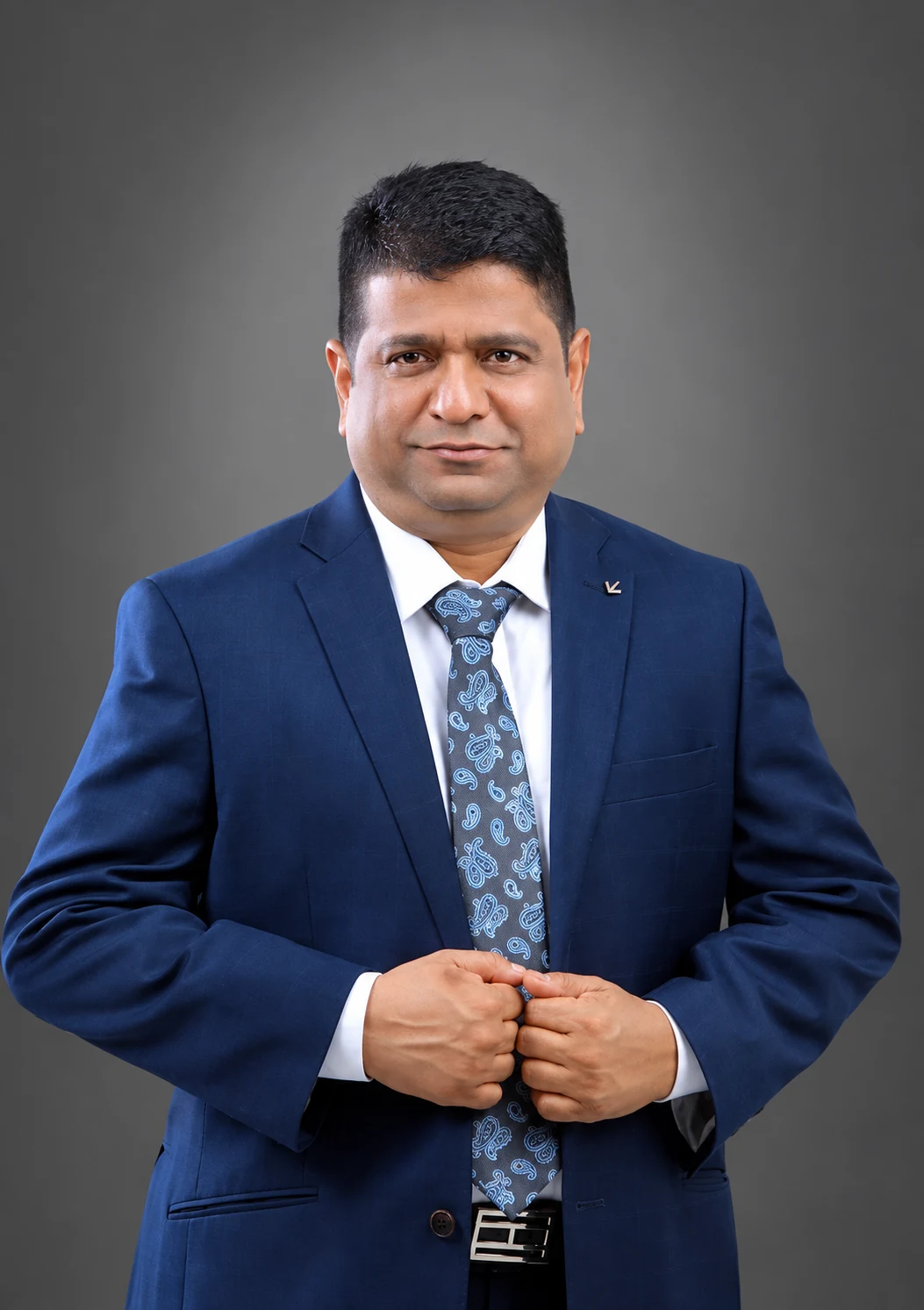
Shyam Sarrof
CPA (USA), CMA (USA), ACA, ACMA, CS, CFA, ACTM, MBA, B.Com (H)
22+ Years in Finance, Reporting, Valuation & Advisory | 13+ Years Guiding Finance Candidates
Shyam brings more than 22 years of professional experience across finance, financial reporting, analysis, controls, valuation and business advisory, together with over 13 years of professional training experience.
For CFA candidates in Oman, he connects the curriculum with financial decisions across banking, investment, energy, large corporates and GCC financial environments. His sessions bring practical context to Ethics, Financial Statement Analysis, Corporate Issuers, Equity, Fixed Income, Portfolio Management and valuation.
Shyam helps candidates interpret longer scenario-based questions, identify the information that matters, distinguish close alternatives and connect accounting or valuation concepts with the investment decision being tested.
Faculty perspective: CFA preparation becomes more manageable when concept learning and question practice develop together. Starting serious question-solving only in the final weeks leaves too little time to correct weaknesses.

Sumanth M
CFA Charterholder | B.Tech (IIT) | MBA (ISB)
CFA Levels I, II & III Faculty | Investment Analysis & Exam Preparation
Sumanth is a CFA charterholder with a strong analytical and investment-management background who helps Oman-based candidates work systematically through the technical depth of CFA Levels I, II and III.
His teaching breaks complex areas into clear decision frameworks across Quantitative Methods, Economics, Equity, Fixed Income, Derivatives, Alternative Investments and Portfolio Management. He shows candidates how concepts connect and how the same principle can be tested from several angles.
A major part of his approach is question deconstruction and revision discipline. Candidates practise identifying what a vignette is testing, selecting the right framework or calculation, reviewing mistakes and converting them into a targeted plan.
Faculty perspective: The most reliable CFA study process is repetitive and measurable: understand the concept, apply it to questions, analyse mistakes, revisit the topic and test it again under exam conditions.
EduDelphi Tuition and CFA Institute Fees Are Separate
EduDelphi course fee
Quoted in OMR based on the CFA level, delivery route, schedule and confirmed study package.
Official CFA Institute fees
Paid separately in USD to CFA Institute. The total depends on level, registration timing and the active fee schedule.
For the 2026 exam cycle, CFA Institute states an estimated total exam-fee range of approximately USD 3,520 to USD 4,570 across all three levels. Membership fees apply separately when pursuing the charter.
| 2026 CFA Institute fee | Early registration | Standard registration |
|---|---|---|
| Level I | USD 1,140 | USD 1,490 |
| Level II | USD 1,140 | USD 1,490 |
| Level III | USD 1,240 | USD 1,590 |
| One-time programme enrolment fee | USD 0 | USD 0 |
| Reschedule an appointment within the same window | USD 250, subject to applicable taxes, deadlines and availability | |
Career Paths for CFA Candidates and Charterholders
CFA knowledge is relevant to investment analysis, portfolio and wealth management, valuation, research, corporate finance, risk and financial advisory roles across Oman.
Financial Analyst
About OMR 663/monthReported range around OMR 290-1,772
Investment Analyst
About OMR 1,142/monthReported range around OMR 689-1,772
Risk Analyst
About OMR 1,280/monthReported range around OMR 1,024-1,536
Finance Manager
About OMR 1,382/monthReported range around OMR 482-2,658
Group Finance Manager
About OMR 2,299/monthReported range around OMR 1,476-3,593
Other relevant paths
Equity research, portfolio analysis, wealth management, valuation, treasury, advisory and capital-markets roles.
Salary references updated September 2026 from user-reported Oman market data published by Naukrigulf. Samples and methodologies vary by role. These are market references, not guarantees. Compensation depends on experience, employer, sector, responsibility and allowances.
Oman is actively developing its financial and investment ecosystem under Vision 2040, including initiatives to deepen financing and capital markets. This creates a relevant local backdrop for skills in valuation, portfolio analysis, investment research and financial decision-making, but does not imply that a CFA credential guarantees employment.
CFA vs FRM, CPA, CMA and ACCA: Which Path Fits You?
| Qualification | Best aligned with | Oman course |
|---|---|---|
| CFA | Investment analysis, valuation, portfolio and wealth management | This page |
| FRM | Financial risk measurement, markets and risk management | FRM course in Oman |
| US CPA | Accounting, audit, reporting and the US licensure pathway | US CPA course in Oman |
| US CMA | Management accounting, FP&A, costing and business finance | US CMA course in Oman |
| ACCA | Accounting, reporting, audit and broader finance-function careers | ACCA course in Oman |
See How We Teach a CFA Valuation Scenario
Original EduDelphi practice scenario
A company is expected to pay a dividend of OMR 1.80 next year. Long-term dividend growth is estimated at 4%, and the required return is 9%.
Task 2: If the required return rises to 10% while all other assumptions remain unchanged, estimate the new value.
Task 3: Explain why the valuation changes.
Trainer reasoning: At 9%, estimated value is OMR 1.80 ÷ (0.09 – 0.04) = OMR 36. At 10%, it is OMR 1.80 ÷ (0.10 – 0.04) = OMR 30. The valuation falls because the required return rises while the expected dividend and growth rate stay the same. The question tests calculation, interpretation and the investment logic behind the result.
This original EduDelphi learning scenario is not an official, recalled or live CFA examination question.
Live Online, Muscat Classroom and Flexible Study Routes
CFA preparation is available to professionals across Muscat, Sohar, Salalah, Nizwa, Duqm and wider Oman.
Live online classes
Join interactive teaching from anywhere in Oman with recordings and LMS access.
Muscat classroom options
Study in person through available classroom or private routes in Muscat.
Self-paced preparation
Use structured resources, recordings, questions, mocks and faculty support around your schedule.
One-to-one support
Build a focused route around your level, weak areas and target exam date.
Weekend and weekday options
Discuss schedules that work around professional and personal commitments.
Employer-sponsored learning
Use invoice, purchase-order and private-cohort routes where required.
Private CFA Preparation for Finance and Investment Teams
EduDelphi supports banks, investment firms, corporates, government-linked organisations and other employers through private CFA preparation and broader investment-capability programmes.
- Private Level I, II and III cohorts
- Schedules planned around business requirements
- Live online, onsite and blended delivery
- Attendance and progress reporting
- Purchase-order and employer invoicing support
- Custom finance, valuation and investment programmes
Investment capability programmes can also be scoped around valuation, financial modelling, portfolio analysis, fixed income, investment research and ethics without requiring every participant to register for the CFA Program.

What CFA Learners Say About EduDelphi
“I had a great learning experience with EduDelphi. Special thanks to Mr. Shyam and Mr. Dugresh for being extremely supportive, and always available to guide us throughout the program. Practical approach made the sessions highly engaging and valuable.”
“The teaching materials and the question bank provided by Delphi Star Training was comprehensive and concise. The guidance, motivation, and coaching provided by the coach were excellent. The classes on weekend was an added advantage for me.”
“Interactive platform and supportive team.”
Course Guidance from Our Muscat Office
Speak with the EduDelphi Oman team about CFA levels, course fees, exam windows, study routes and corporate requirements.
Address
Street 3701, Al Ghubrah South, Postal Code 130, Muscat, Oman
Email
[email protected]
Phone
+971 4 396 3634
Get CFA Fees, Syllabus and Batch Options
Tell us your current level, preferred way to study and target exam window. We will send current OMR tuition, schedules, course inclusions and the relevant syllabus.
Plan Your CFA Preparation in Oman
Receive a clear course recommendation for Level I, Level II or Level III.
- EduDelphi tuition and CFA Institute fees explained separately
- Live, classroom, self-paced, one-to-one and corporate options
- Kaplan Schweser and EduDelphi resources confirmed in writing
CFA Course and Exam Questions for Oman Candidates
What is included in the EduDelphi CFA course?
Your selected package can include 100+ guided hours per level, Kaplan Schweser resources, 4,000+ practice and revision questions, mock exams, recordings, LMS access, mind maps, notes, revision strategies and direct faculty support.
Does EduDelphi teach CFA Level I, II and III?
Yes. EduDelphi provides preparation across all three CFA Program levels, including the current Level III pathways.
How many hours should I study for a CFA exam?
CFA Institute describes successful candidates as investing more than 300 hours per level on average. Actual preparation time depends on prior knowledge, level, schedule and study efficiency.
Can I study CFA online from Oman?
Yes. Live online, recorded and self-paced routes are available across Oman. Muscat classroom, private and corporate options can also be discussed.
Are CFA Institute fees included in EduDelphi tuition?
No, unless a written quotation explicitly states otherwise. EduDelphi tuition is quoted in OMR. Official CFA Program registration and exam charges are paid separately to CFA Institute.
What are the CFA Level III pathways?
The current pathways are Portfolio Management, Private Markets and Private Wealth. The selected pathway represents part of the Level III exam and cannot be changed after registration. CFA Institute states that the pathway does not change the CFA charter awarded.
What score do I need to pass a CFA exam?
CFA Institute does not publish one fixed percentage that guarantees a pass. Each level uses a Minimum Passing Score established and maintained through CFA Institute’s standard-setting and equating process. Candidates receive a pass or fail result rather than a simple fixed-score rule.
Do I need to complete a Practical Skills Module?
Yes. Candidates must complete one Practical Skills Module at each level before results are released. The same module cannot be used to satisfy the requirement at two different levels.
How long do CFA exam results take?
CFA Institute currently indicates approximately five to seven weeks for Levels I and II and six to eight weeks for Level III after the examination, provided the required PSM has been completed.
Can I take the CFA exam in Oman?
CFA examinations use an international computer-based test-centre network. Oman availability can change by window, so check the official CFA Institute and test-centre scheduling system before finalising an exam date or travel plan.
Can I change my CFA exam appointment?
CFA Institute currently charges USD 250 to reschedule an appointment within the same exam window, subject to deadlines, availability and applicable taxes.
How many times can I attempt a CFA exam level?
CFA Institute currently permits a maximum of six attempts per exam level and a maximum of two attempts per calendar year where available. Attempts cannot be in consecutive windows or in windows less than six months apart.
Is the CFA designation recognised in Oman?
The CFA charter is an international investment-management designation, not an Oman-specific occupational licence. Oman employers may list CFA as required, preferred or advantageous for investment, portfolio, financial-analysis and related roles. Requirements vary by employer and position.
Can I call myself a CFA after passing Level III?
No. Passing all three examinations is a major milestone, but the CFA designation may only be used by eligible CFA charterholder members in good standing. The charter also requires qualifying work experience, membership, references and other current CFA Institute requirements.
Is Arabic support available?
The CFA examination is in English. Arabic guidance can be discussed for selected learner-support needs, while technical exam preparation remains aligned to the English curriculum.
Does CFA guarantee a job or salary in Oman?
No. CFA can strengthen investment and analytical knowledge, but employment and pay depend on experience, role, employer, sector, communication and market conditions.
Build a Clear Plan for Your CFA Exam
Request current Oman fees, available schedules, the correct exam-year syllabus and the right preparation route for your level.
CFA® and Chartered Financial Analyst® are registered trademarks owned by CFA Institute.