Build End-to-End Supply-Chain Knowledge
Connect planning, sourcing, inventory, operations and logistics with the decisions that affect cost, service and resilience.
The Certified Supply Chain Professional course in Oman combines instructor-led preparation with practical application. Work through the eight CSCP modules, understand why close answer choices differ, and use mock reviews to turn mistakes into a focused revision plan.
EduDelphi provides teaching and preparation support. The APICS CSCP credential sits within ASCM’s certification portfolio; completing our training does not itself award CSCP certification.

CSCP Course Fees, Batches and Delivery in Oman
Get a written quotation for your preferred study route, with tuition and official ASCM products clearly separated.
EduDelphi tuition
Our default quotation is tuition-only: guided classes, EduDelphi learning resources, recordings, practice, mocks and preparation support. Request the current course fee in OMR and the available batch options.
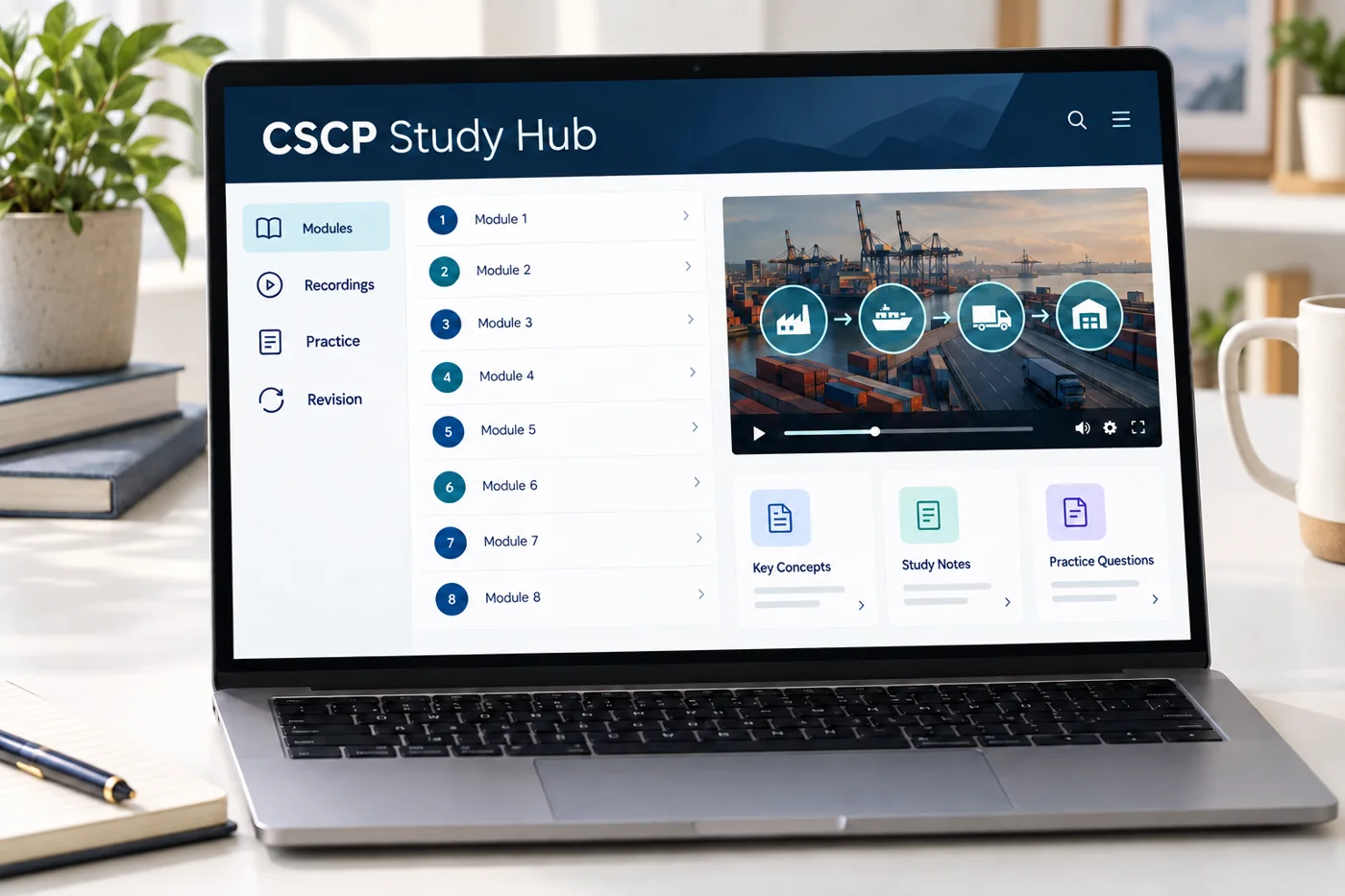
- 40+ guided hours covering all eight modules.
- Classroom and live-online study options.
- Weekday, weekend and fast-track schedules.
- Private learning and employer-sponsored cohorts.
- Faculty support, classroom recordings and revision resources.
Your preferred schedule, starting point and learning format help us recommend a suitable route. Confirm the actual dates and classroom venue with your quotation.
Optional official arrangements
Official ASCM Learning System materials and exam arrangements can be requested separately. They are not included by default; your quotation identifies each official product and charge when selected.
ASCM membership, examination registration, conditional retakes and certification maintenance are governed by ASCM’s current terms. EduDelphi resources and the official ASCM Learning System are different products.
Official ASCM CSCP cost references
Published 2026 reference prices below are in USD, separate from EduDelphi tuition. Eligible pricing means ASCM membership with the Certification Upgrade. Confirm the current cart, buyer tier, taxes, shipping and any membership additions before purchase.
| Official product | Eligible member + upgrade | Other buyer tier |
|---|---|---|
| CSCP Learning System only | US$1,450 | US$2,015 |
| CSCP bundle | US$2,620 | US$3,650 |
The bundle combines the Learning System, exam and a conditional 2nd Chance Exam. Learning System prices are not standalone exam fees. Do not add courseware again when already included in a bundle. References: ASCM CSCP products and ASCM’s published 2026 comparison. See our CSCP fees and total-budget guide for further context.
Who Should Take the CSCP Course?
CSCP suits professionals who need to understand how decisions across the supply chain affect one another.
Functional specialists
Planners, buyers, inventory controllers, warehouse and logistics professionals developing a broader understanding beyond their own function.
Cross-functional professionals
Supply-chain, operations and project professionals connecting customer requirements, suppliers, capacity, cash and delivery performance.
Employer-sponsored teams
Teams seeking a common supply-chain vocabulary alongside structured preparation for the official professional examination.
What Is Included in the CSCP Course?
Teaching, practice and feedback work together, so you know what to study next and why.
Live guided teaching
40+ hours of concept explanation, application, calculations and discussion across the eight current modules.
Questions and mock exams
3,000+ practice questions, module quizzes, mixed-topic practice and multiple timed mocks with answer review.
LMS and recordings
Organised study resources, online and classroom recordings, notes, mind maps, flashcards and topic summaries.
Faculty and revision support
Doubt resolution, question debriefs, calculation practice, mock analysis and revision focused on the areas needing attention.
Practical case resources
An Oman-relevant connected supply-chain case, decision worksheets, risk-register exercises and KPI discussion.
Exam and career guidance
Study planning, official registration-process guidance, CV positioning and interview preparation relevant to supply-chain roles.
Official ASCM materials, exam products and membership remain optional, separately itemised arrangements. Your enrolment documents confirm the resources and commercial terms for your chosen route.
What You Study in the CSCP Course
Learn the extended supply chain from suppliers through operations and distribution to the end customer.
1. Supply Chains, Demand Management, and Forecasting
Supply-chain concepts, customer requirements, demand patterns, forecasting and demand-supply alignment. Connect strategic priorities with the information needed to plan effectively.
Apply it: distinguish a genuine demand change from a supply constraint, and explain the service and inventory consequences before changing the plan.
2. Global Supply Chain Networks
Network design and configuration, product and information flows, visibility, data quality, performance measures and trade-offs across locations and partners.
Apply it: compare network options by total cost, lead time, service and risk rather than selecting a location on transport price alone.
3. Sourcing Products and Services
Sourcing strategy, make-or-buy decisions, supplier evaluation, total cost, procurement coordination and contractual considerations.
Apply it: compare a lower-price supplier with a more responsive alternative, considering quality, reliability, working capital and disruption exposure.
4. Internal Operations and Inventory
Operations alignment, capacity considerations, inventory policies, replenishment, process performance and the financial effect of stock decisions.
Apply it: assess whether a service problem comes from demand assumptions, inventory positioning, capacity or execution before increasing stock.
5. Forward and Reverse Logistics
Transport, warehousing, distribution, fulfilment, international movement, returns and recovery. Examine how physical flows affect customer service and cost.
Apply it: weigh consolidation against speed, and include returns, handling and recovery in the decision rather than treating them as afterthoughts.
6. Supply Chain Relationships
Customer and supplier relationships, segmentation, collaboration, shared measures, incentives and cross-functional coordination.
Apply it: identify where local targets conflict, then propose shared measures and communication that improve end-to-end performance.
7. Supply Chain Risk
Risk identification, assessment, response, continuity and resilience across suppliers, networks and operating processes.
Apply it: distinguish exposure from an actual event, prioritise a proportionate response and establish ownership, monitoring and escalation.
8. Optimization, Sustainability, and Technology
Continuous improvement, sustainability considerations, technology evaluation, implementation and change. Connect improvement proposals to strategic and operational objectives.
Apply it: assess whether a technology proposal addresses the underlying problem and what process, data and people changes are necessary.
Module names follow the official ASCM CSCP programme. EduDelphi’s quizzes, mocks and revision support are preparation activities, not additional official modules. Refer to the current official content and materials for your examination.
How Your CSCP Study Plan Works
A clear learning sequence, adapted to your starting point and work schedule.
- DiagnoseIdentify foundations, calculations and unfamiliar topics.
- Learn and applyConnect concepts with supply-chain decisions.
- Practise and reviewUse explanations and an error log.
- Mock and reviseTest timing and revisit weak areas.
Use classes to understand the reasoning, recordings to revisit difficult explanations, and independent study to consolidate the material. Your 40+ guided hours are the instructional component, not a promise that attendance alone makes you exam-ready.
ASCM recommends approximately 100 hours of study on average for its certification examinations. Your needs depend on experience, confidence with calculations, available study time and performance on fresh practice. The study plan should respond to that evidence rather than force everyone into the same calendar.
CSCP Practice Questions, Mock Exams and Revision
Use 3,000+ questions and multiple mocks to improve judgement, not just remember answers.
Practice with a purpose
- Module-wise questions after concept teaching.
- Mixed-module questions connecting several decisions.
- Timed mocks to review pacing and concentration.
- Answer explanations and faculty-led debrief.
- Error logs and targeted revision tasks.
A useful review asks why the preferred answer fits the objective, why alternatives fall short and what information could change the decision. A higher score from repeating the same questions is not the same as stronger performance on unfamiliar scenarios.
Try a supply-chain decision question
A distributor lowers its purchase price by ordering larger quantities. Inventory and write-offs rise, while customer availability does not improve. What is the most useful next analysis?
See the reasoning
C is the best response. Unit-price savings may be outweighed by holding costs, obsolescence and a poor replenishment policy. Review the end-to-end effect before choosing a change. Passing the problem to another function does not resolve the trade-off.
Original EduDelphi teaching question. Not official, recalled or live ASCM examination content.
CSCP LMS, Recordings and Study Resources
Keep classes, practice and revision connected between teaching sessions.
Revisit online and classroom recordings, work through topic notes, and use summaries, mind maps, infographics and flashcards to organise the content. Study planners and error logs help turn broad revision into specific tasks.
- Review the explanation behind a difficult concept.
- Practise related questions and calculations.
- Record unresolved questions for faculty support.
- Return to weaker topics before another timed mock.
These are EduDelphi preparation resources. The separately purchased official ASCM Learning System has its own materials, tools and terms.
Meet Your CSCP Trainers
Exam reasoning and practical supply-chain execution, taught as connected skills.

S. K. Avinash
CPIM | CSCP | CIPS Level 4 | CIPM | PMP | CPPM | Six Sigma
13+ Years in Supply Chain, Planning & Professional Training
Avinash brings a structured, exam-focused approach to ASCM CSCP preparation. He connects supply-chain strategy with planning, sourcing, inventory, operations and customer fulfilment.
His Oman and GCC examples span oil & gas, manufacturing, logistics, trading, FMCG, construction and industrial organisations. Sessions cover demand and supply planning, supplier management, capacity, risk, sustainability and end-to-end integration.
He focuses on ASCM question logic, scenario interpretation, elimination techniques and mock analysis, explaining the business reasoning behind the preferred answer.

Anirban Mondal
CSCP | MBA – Logistics & Supply Chain | Supply Chain, Logistics & Operations Faculty
10+ Years in Logistics, Operations & Supply Chain Analysis
Anirban brings the practical execution perspective to CSCP, connecting international sourcing, procurement coordination, warehousing, transportation, inventory movement and regional distribution.
His Oman-focused scenarios examine long supplier lead times, imported materials, port and freight flows, 3PL operations, project logistics, warehouse constraints and GCC distribution networks.
He shows how sourcing, planning and logistics decisions affect cost, working capital, lead times, resilience and customer service, making interconnected CSCP scenarios easier to apply.
Corporate CSCP Training in Oman
Prepare a team for the same professional examination while making the learning relevant to your supply chain.
Arrange private cohorts for planning, procurement, inventory, operations and logistics teams. Delivery can be client-site, classroom or live online, with schedules built around shifts, planning cycles and business priorities.
We connect the full CSCP scope with your industry and operating context. Company examples can clarify the concepts without replacing the examination syllabus with a narrow departmental workshop.
- Pre-programme skills diagnostic and cohort planning.
- Oil & gas, manufacturing, FMCG, trading and logistics cases.
- Topic quizzes, mocks, feedback and revision planning.
- Attendance and appropriate progress summaries for L&D.
- Confidential individual feedback and faculty support.

Certification preparation or a practical team workshop?
An employer-sponsored CSCP cohort prepares candidates for ASCM’s official examination. A customised capability workshop may instead focus on a specific business problem. We can help select the appropriate route; neither attendance nor an internal workshop automatically awards CSCP certification.
Share your team size, roles, preferred delivery and objectives. The proposal separates tuition from any optional official ASCM arrangements. Explore our wider corporate training in Oman.
CSCP Exam, Eligibility and Certification
Understand the official examination separately from your preparation course.
| Official item | Reference |
|---|---|
| Structure and eligibility | One exam covering eight modules; no formal degree or work-experience prerequisite. |
| Questions and time | 150 multiple-choice questions: 130 scored and 20 pretest; 3.5 hours. |
| Passing standard | 300 or above on a 200-350 scaled range, not a raw percentage target. |
| Delivery | Pearson test centre or OnVUE online proctoring, subject to current requirements and availability. |
| Retake | 14-day waiting period; applicable official purchase and retake conditions. |
| Maintenance | 75 professional-development points every five years under ASCM’s current requirements. |
Sources: ASCM exam details, ASCM FAQs, maintenance requirements and Pearson APICS testing guidance. Reference review: 17 October 2026. Current official terms prevail.
From preparation to the official credential
Prepare with your selected resources → purchase the official exam product → receive your Authorisation to Test (ATT) → book an available Pearson appointment → take the official exam → maintain the credential after award.
For candidates in Oman, confirm the actual centre or OnVUE option in the official scheduling system. Buying an exam is not the same as booking an appointment; follow the “take exam by” date in your account and confirmation.
Exam deadlines, changes and conditional second chance
Exam-credit expiry, ATT validity and Learning System access are different deadlines. Follow the terms for your exact purchase route; changing an appointment does not extend ATT validity.
Pearson currently lists a US$45 rescheduling/cancellation fee. Test-centre changes require at least 48 hours’ notice; OnVUE changes can be made up to the appointment time. Call-centre transactions attract an additional US$10 service fee.
The bundle’s 2nd Chance Exam is conditional, not an unconditional free retake. Applicable redemption/testing deadlines and an unsuccessful first attempt matter; a no-show is not the same as a failed attempt. Check the current official conditions before purchase.
CSCP Skills and Supply-Chain Careers in Oman
Use the qualification to strengthen your knowledge and professional conversations, alongside relevant experience.
Oman’s industrial, trading and distribution environments bring together imported materials, supplier lead times, storage constraints, freight choices and service commitments. Professionals need to explain how a decision improves the whole system, not just one department’s target.
Where the learning applies
Supply-chain coordination and management; procurement and supplier performance; demand and inventory planning; operations; logistics and distribution; and cross-functional improvement roles.
For an oilfield supplier, that may mean balancing material availability and cash. For an FMCG distributor, it may mean replenishment, shelf availability and expiry. For an industrial operator, it may mean supplier continuity and production support.
Career support with practical focus
Use course-specific CV positioning, interview preparation and career guidance to explain your experience and the decisions you can support. Discuss case outputs, trade-offs and measures rather than simply listing syllabus headings.
CSCP does not guarantee a job, promotion or salary. Employers consider experience, sector knowledge, systems skills and the responsibilities of the role. Compare actual vacancies and responsibilities when assessing your next career step.
CSCP vs CPIM, CLTD, CIPS and Practical Training
Choose by the work you want to understand more deeply, not by assuming one route is best for everyone.
| Route | Main focus | Consider it when… |
|---|---|---|
| CSCP | Extended, end-to-end supply-chain integration. | You need to connect sourcing, planning, operations, logistics, relationships and risk. |
| CPIM | Planning, inventory and internal supply. | Your work needs greater depth in demand, supply, inventory and detailed planning. |
| CLTD | Logistics, transportation and distribution. | Your responsibilities centre on warehousing, freight, distribution and fulfilment. |
| CIPS Level 4 | Procurement and supply. | Your priority is procurement, sourcing, contracts and supplier relationships. |
| Practical supply-chain training | Applied operational capability. | You want practical learning without making an ASCM examination the primary goal. |
Compare the wider supply-chain courses available in Oman or read our CSCP vs CPIM guide. For a separate applied technology pathway, explore AI for Supply Chain or AI for Procurement; these do not replace CSCP preparation.
Study Across Oman with Muscat Support
Choose classroom, live-online, private or corporate delivery. Our team helps you compare the current schedules and arrangements; confirm the classroom venue before attending.
Live-online study supports professionals across Oman without implying that every city has a permanent EduDelphi classroom.
EduDelphi Oman – Muscat
Street 3701, Al Ghubrah SouthPostal Code 130, Muscat, Oman
[email protected]
Call our regional course team
WhatsApp course enquiries
An Oman Supply-Chain Case You Work Through
A connected decision across sourcing, inventory, logistics, service and cash.
A fictional industrial distributor imports through Sohar and serves customers in Muscat and Duqm. Its main supplier’s lead time rises from 45 to 75 days just as demand increases. A local alternative is faster but more expensive.
Sales wants availability. Finance wants less cash tied up. Operations faces warehouse constraints, while expediting and returns are adding cost. Which decisions improve the total outcome?
- Clarify demand assumptions and customer priorities.
- Compare supplier total cost and continuity exposure.
- Evaluate inventory, service and working-capital options.
- Consider freight, distribution and reverse flows.
- Recommend ownership, communication and KPIs.

What you produce
A demand-assumption sheet, network map, supplier comparison, inventory/service options, risk register and a short recommendation supported by measures. The goal is to explain the trade-off, identify missing information and justify a coordinated response.
A cheaper purchase price, a larger buffer or a faster shipment can each be sensible in context. None is automatically the best answer without examining the customer need, cost, constraints and risk together.
Original EduDelphi teaching case with illustrative figures, not a real client result or official ASCM examination question. Course imagery is AI-generated illustration; trainer portraits are authentic faculty photographs.
CSCP Course and Certification FAQs
Clear answers about the course, official examination, costs and support.
Do I need a degree or experience to take CSCP?
No formal degree or work-experience prerequisite is currently required. Preparation needs still vary. We use a diagnostic to identify foundations and study priorities, not to create an ASCM eligibility barrier.
What is the difference between ASCM, APICS and EduDelphi?
ASCM is the Association for Supply Chain Management. APICS is the certification brand associated with CSCP. EduDelphi provides preparation, resources and learner support; it does not award the official CSCP credential.
Are the official materials and examination included?
Not by default. Our standard quotation is tuition-only. Optional ASCM Learning System materials and exam arrangements are separately itemised when requested. Check your written quotation rather than assuming that every official product is included.
How much teaching is included, and how long should I prepare?
The course includes 40+ guided hours. Independent preparation is also important. Your study plan depends on experience, workload and practice performance; a fixed number of class hours is not a guarantee of readiness.
Can I study in a classroom or online?
Yes. Classroom, live-online, private and corporate routes are available, with flexible weekday, weekend and fast-track options. Ask for current schedules and the confirmed venue for your selected classroom arrangement.
Are classroom recordings and faculty support available?
Yes. Online and classroom recordings, LMS resources, extensive revision materials and faculty support help you revisit concepts and resolve questions. Your enrolment documents explain the terms of the selected course route.
Can I take the CSCP exam from home in Oman?
ASCM offers an OnVUE online-proctored route alongside eligible Pearson testing centres. Confirm programme and location availability, identity and room requirements, and the official system check before choosing your appointment.
What score do I need to pass CSCP?
A scaled score of 300 or above on the 200-350 range passes. It is not a raw percentage calculation. Use practice results to identify revision needs rather than convert them into an official scaled-score prediction.
Is a second CSCP attempt free?
Only where an applicable official product includes a conditional 2nd Chance Exam and its terms are satisfied. A no-show is not equivalent to an unsuccessful attempt. Otherwise, current official retake charges apply; ASCM requires a 14-day wait.
How do I maintain CSCP after passing?
ASCM currently requires 75 professional-development points every five years, with the applicable maintenance submission and fees. Track your activities and evidence using the current official maintenance guidance.
Does CSCP guarantee a job or higher salary?
No. It can support professional development, but recruitment and pay depend on experience, role and employer needs. EduDelphi provides course-specific career guidance, CV positioning and interview preparation, not a guaranteed employment outcome.
Can my employer arrange a private CSCP cohort?
Yes. We can organise classroom, client-site or live-online preparation around your team’s schedule, with diagnostics, relevant cases, question practice, mocks and progress review. Request a proposal with tuition and any official arrangements separately identified.
Get CSCP Fees, Syllabus and Oman Batch Options
Tell us your current role and preferred delivery. Our team will share the current tuition, written inclusions, available schedules and optional official ASCM arrangements.
- Find a suitable classroom, online, private or corporate route.
- Understand what your preparation package includes.
- Separate tuition from official materials and exam costs.
- Plan your next study step with course-specific guidance.
Request CSCP Course Details
Complete the enquiry and our course team will respond.