AI for Supply Chain Course in Oman
Use AI for better planning, inventory and logistics work.
24 hours of live, hands-on training with a reviewed project and two follow-up clinics. Learn to analyse information, check AI answers and prepare clear decisions.

AI for Supply Chain Course Overview
Practical AI skills for the supply-chain work you do every week.
AI for Supply Chain training teaches you to use suitable AI tools for planning, inventory, logistics reporting and decisions. You learn to prepare reliable information, ask useful questions and check the result before acting on it.
EduDelphi combines live teaching, guided exercises and feedback. Work through one connected case, then prepare a decision pack that explains the numbers, the options and the next action.
Join from anywhere in Oman. Choose classroom, live-online, private or company training with a schedule that suits you.
Course details
- Duration: 24 guided hours, including the project.
- Follow-up: two additional clinics.
- Level: working professionals; no coding required.
- Practice: Excel, Power Query and approved AI tools.
- Support: LMS, recordings, editable files and feedback.
- Certificate: EduDelphi / Delphi AI Academy completion.
- Fees: request your OMR quotation.
What You Will Learn to Do
Prepare reliable information
Clean exports, reconcile totals and check dates, units and missing records before using AI.
Compare planning and stock options
Review forecasts, inventory and supply constraints. Explain the assumptions behind a recommendation.
Explain logistics exceptions
Identify delivery, service and lead-time issues. Prepare a clear action list with evidence and owners.
Create checked decision reports
Use AI to support analysis and drafting, then verify the numbers and keep the right approvals in place.
Who Should Join This Course?
Planning and inventory professionals
For demand planners, materials teams, inventory staff and analysts who want practical AI support with recurring decisions.
Logistics and operations teams
For warehouse, transport, distribution and operations professionals working with service, shipment and performance information.
Managers and team leaders
For people reviewing operational reports, comparing options and setting priorities across functions.
Company teams
For organisations building a consistent way to use approved AI tools, review outputs and apply learning to real work.
New to the subject? Basic spreadsheet familiarity helps. Optional Excel support is available. If you need a broader foundation first, explore our logistics and supply-chain course. There is no mandatory entry test.
AI for Supply Chain Course Syllabus
Eight practical modules across 24 guided hours. Exercises and project review are included; two follow-up clinics take place separately. Choose eight three-hour sessions or an agreed intensive format.
1. AI for Supply Chain: Useful Tasks and Data Rules (2 hours)
Separate generative AI, predictive models and rule-based automation. Choose tasks by value, frequency, data readiness, risk and review effort. Decide what information belongs in an approved environment.
2. Prepare Supply-Chain Data and Check AI Answers (3 hours)
Use Excel and Power Query to review identifiers, units, dates, duplicates and missing information. Reconcile totals, keep source records and test the AI explanation against the evidence.
3. Use AI to Support Demand Forecasting (4 hours)
Compare a simple forecasting baseline with actual demand. Reserve a test period, review forecast errors and explain drivers. Use AI to support the analysis while checking calculations and limitations.
4. Analyse Inventory and Replenishment Decisions (4 hours)
Review stock, service, lead times and replenishment exceptions. Compare assumptions and working-capital effects. Explain what should be investigated before changing a stock policy.
5. Compare Supply, Capacity and S&OP Options (3 hours)
Compare demand and supply scenarios, capacity constraints and service trade-offs. Turn the analysis into a short S&OP recommendation with assumptions, evidence and a clear decision owner.
6. Review Logistics Performance and Disruption (3 hours)
Analyse shipment, fulfilment, cost and service exceptions. Compare mitigation options and identify missing evidence. Prepare actions without inventing causes or claiming a route is optimal.
7. Build a Reviewed AI Reporting Workflow (2 hours)
Map source data, calculations, AI assistance, validation, exceptions and approval. See one bounded automation demonstration and learn when to return to a manual process.
8. Supply-Chain AI Project and Action Plan (3 hours)
Connect the data, analysis and recommendation in one project. Receive feedback, improve the work and prepare a 30-day application plan with a baseline and practical review points.
Tools Used in the Course
The course focuses on useful supply-chain work. Excel and Power Query support checked calculations and data preparation. Approved AI tools help with analysis, explanations and reporting.
 Excel
 Power Query
 Copilot
 ChatGPT
| Learning depth | What it covers |
|---|---|
| Core hands-on | Excel, Power Query and an approved GenAI environment. |
| Guided alternatives | Suitable Copilot or other approved tools, matched to the learning environment. |
| Demonstration | One reporting or automation workflow with validation and human approval. |
| Custom or advanced | Planning systems, ERP context, APIs, Python and deeper agent development through an agreed programme. |
Practical arrangements are confirmed before training. For general spreadsheet workflows across roles, see the Excel with AI course.
See an AI-Assisted Supply-Chain Decision
A receipt is on order. But will it arrive before the goods are needed?
In this fictional Oman distributor exercise, item OM-101 has 240 usable units and another 160 arriving by day 10. Demand by that date is 520 units. A further 200 units arrive on day 12.
| Source fact | Units | What to check |
|---|---|---|
| Usable stock | 240 | Exclude damaged or blocked stock. |
| Receipts by day 10 | 160 | Use the actual arrival cutoff. |
| Available by day 10 | 400 | 240 + 160 |
| Demand by day 10 | 520 | Match the item, units and period. |
| Shortfall | 120 | The later 200-unit receipt does not remove this shortage. |
“There is enough stock because 360 units are on order.”
The draft counts a later delivery too early. It also confuses an order with usable stock at the required time.
Confirm the 120-unit gap. Compare feasible transfers, approved partial fulfilment or expediting. Check cost and service effects before the responsible manager approves the action.
Learners practise checking the data, correcting the answer and explaining a decision. Costs and supplier commitments must be obtained, not invented by the AI tool.
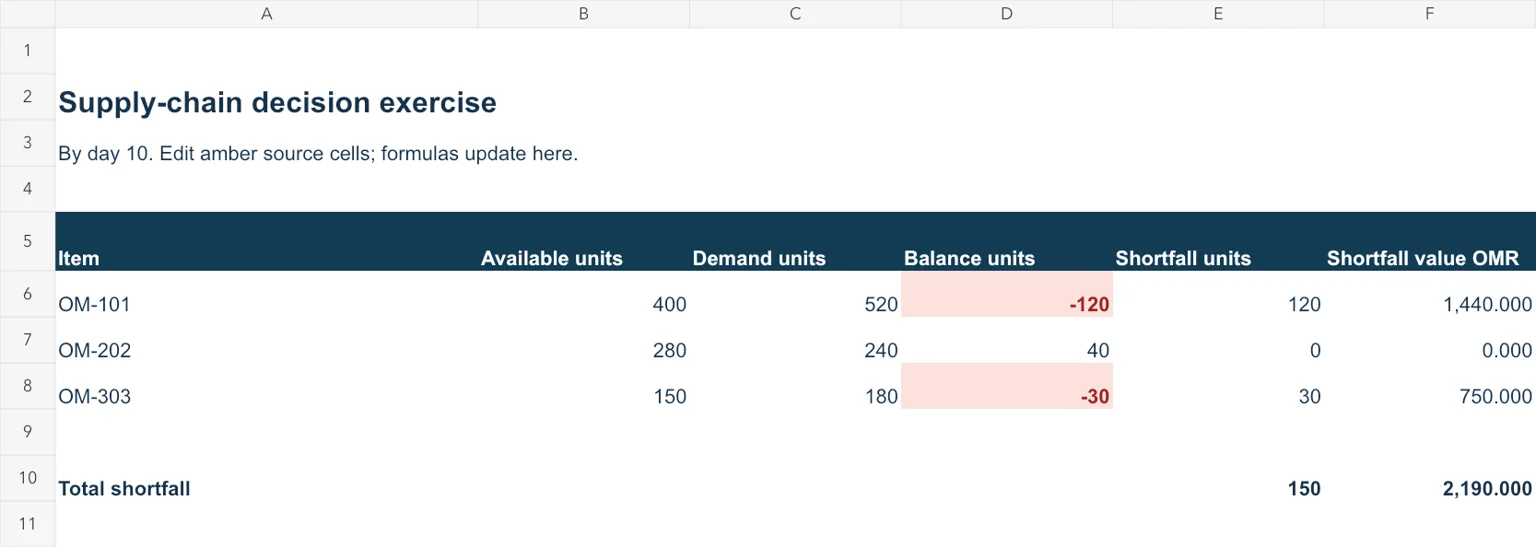
Excerpt from the course workbook. Synthetic teaching data, not a client case study.
Your Project and Learning Resources
One connected supply-chain project
Work from a synthetic dataset through planning and logistics analysis to a recommendation. Review the sources, check the calculations and improve your work through feedback.
Editable workbooks and checked examples
Use starter material, worked calculations and a data dictionary. Keep useful methods for recurring work.
Decision and workflow templates
Prepare a management brief, action register, prompts, approval checks and a manual fallback.
LMS, recordings and direct support
Revisit lessons, demonstrations and resources between sessions. Ask questions as you practise.
Project feedback and two clinics
Get feedback on data quality, reasoning, verification and usefulness. Return to selected applications in two additional follow-up sessions.
The final project is a checked decision pack, supported by a practical 30-day application plan. You leave with reusable work, not only a list of AI features.
Corporate AI for Supply Chain Training in Oman
Build useful AI skills around your team’s planning, inventory and logistics work.
EduDelphi can adapt training to your processes, approved tools and business examples. Bring planners, operations staff, managers and relevant IT or data colleagues into a shared way of working.
Choose corporate onsite, private classroom or live-online delivery across Oman. Company exercises can use sanitised exports, reports and realistic scenarios.

Choose recurring work
Select reports, stock reviews, planning decisions or logistics tasks worth improving.
Agree tools and safe data
Use approved environments and sanitised examples with clear information boundaries.
Adapt the exercises
Reflect the team’s data formats, roles, reporting style and review process.
Train by role
Guide employees through the work they need to understand, produce and check.
Review team outputs
Give practical feedback on calculations, reasoning, evidence and recommendations.
Follow up
Use clinics to review application, correct errors and agree useful next steps.
Choose the right team format
Focused workshop
A shorter route to select useful tasks, understand data rules and see a practical example.
Full practical course
The 24-hour course with guided exercises, reviewed project and two additional clinics.
Custom company programme
Adapt the teaching around departments, planning systems, internal processes and agreed learning outcomes.
Need a wider programme across departments? Explore corporate AI training in Oman. Implementation and live system integrations can be discussed and separately scoped.
Organisations EduDelphi Has Delivered AI Training For
Selected organisations that have received AI training from EduDelphi.
















Supply-Chain Examples for Oman Workplaces
Distribution and imported goods
Review uncertain lead times, delayed receipts, stock availability and service priorities in a fictional Muscat distribution case.
Industrial materials and operations
Use a Sohar-style industrial scenario to compare materials availability and service risk. Identify what needs checking before recommending action.
Logistics and multi-location delivery
Review shipment and fulfilment exceptions in Salalah or Duqm scenarios. Explain options, assumptions and the next responsible action.
Planning and management reporting
Turn checked findings into a short decision brief. Practise English or bilingual communication without changing the numbers or item codes.
These fictional teaching scenarios help you practise with relevant work problems. Company programmes can use agreed, sanitised examples from your own operations.
Choose the Right Supply-Chain or AI Course
| Your main goal | Learning route |
|---|---|
| Use AI for planning, inventory, logistics and checked decisions | AI for Supply Chain |
| Use AI for spend, sourcing, suppliers, bids and procurement documents | AI for Procurement course |
| Build practical logistics and supply-chain foundations | CLSCMP logistics and supply-chain course |
| Prepare for a professional planning/inventory qualification | CPIM certification preparation |
| Prepare for an end-to-end supply-chain qualification | CSCP certification preparation |
| Use AI for spreadsheet tasks across business roles | Excel with AI |
For wider choices, compare supply-chain courses in Oman or explore AI courses in Oman.
AI for Supply Chain Training Across Oman
Choose classroom, live online, private learning or company onsite training.
Training is available nationwide, including Muscat, Sohar, Salalah, Duqm, Nizwa, Sur and other agreed locations. Request a suitable schedule and delivery plan. Classroom venues and dates are confirmed with your course details.
EduDelphi in Muscat
Street 3701, Al Ghubrah SouthMuscat 130, Oman
Call +971 52 908 6650
WhatsApp +971 52 833 7694
[email protected]
English, Arabic and bilingual learning
Choose teaching in English, Arabic or a bilingual format. Practical communication exercises can reflect your team’s working language.
Live-online learning supports professionals anywhere in Oman. Private and corporate programmes can be arranged around role, location and scheduling needs.
Course Fees and Completion Certificate
Request your OMR quotation
Ask for the current syllabus, fees and suitable schedule. Your written quotation confirms guided hours, clinics, format, materials, access, practical arrangements, support and applicable charges.
EduDelphi / Delphi AI Academy certificate
Receive a course-completion certificate after completing the training and practical requirements. This is applied professional training, separate from ASCM, CIPS or Microsoft certification examinations.
AI for Supply Chain Course FAQs
Do I need coding experience?
No coding experience is required for the core course. Basic spreadsheet familiarity helps. The course focuses on practical analysis, checked outputs and decisions. Deeper Python, AI-model development and systems integration can be discussed as separate advanced work.
How long is the AI for Supply Chain course?
The course includes 24 guided hours, with exercises and project review inside those hours. Two follow-up clinics are additional. Ask for an eight-session route or another agreed classroom, online, private or company schedule.
Will I practise forecasting or only learn prompts?
You work with a forecasting baseline, actual demand and a held-out test period. You review errors and assumptions, then use AI to help analyse or explain the findings. You check the numerical result rather than accepting a chatbot forecast as fact.
Can our team use company supply-chain data?
Only when the organisation has approved the information, tools and training arrangements. The standard exercises use synthetic data. Company work can use sanitised examples. Check confidentiality, personal information, permissions and your approved environment before uploading anything.
How is this different from CSCP, CPIM or CLSCMP?
This course develops applied AI skills for workplace analysis and reporting. CLSCMP provides broader practical foundations; CSCP and CPIM prepare learners for their respective professional qualifications. These routes can complement each other, but completing this course does not award those credentials.
Does the course cover AI for procurement?
Supplier lead times and delivery performance can appear as inputs to supply-chain decisions. Full spend analysis, sourcing, RFx, bid evaluation, contracts and negotiation are a different specialist focus. Ask about customised procurement or combined team training.
Is Arabic training available outside Muscat?
Yes. English, Arabic and bilingual teaching are available through agreed classroom, live-online, private and corporate formats across Oman. We confirm the location, dates and practical arrangements with your course details.
Can EduDelphi customise the programme for our company?
Yes. Training can reflect your roles, reporting, planning process, approved tools and sanitised company examples. The team route includes practical exercises, reviewed outputs and follow-up. Live integrations and production implementation are discussed separately.
What resources, certificate and support are included?
The course includes editable practice files, checked examples, LMS and recordings, project feedback, direct learning support and two follow-up clinics. Learners receive an EduDelphi / Delphi AI Academy course-completion certificate after meeting the course requirements. Your quotation confirms the access and delivery arrangements.
What are the fees and next course dates?
Fees and scheduling are enquiry-led. Request a written OMR quotation for individual, private or corporate training. We will confirm the format, guided hours, clinics, resources and applicable charges before enrolment.
Start Your AI for Supply Chain Training
Request the syllabus, current fees and a suitable learning plan for you or your team.
- 24 guided hours and a reviewed practical project.
- Two additional clinics, recordings and learning resources.
- Classroom, live online, private and corporate delivery across Oman.