
Prepare for CRISC with Expert Teaching and Support
Build your understanding of technology risk and controls through 40 live faculty-led training hours, 3,000+ practice questions, multiple mocks and personal feedback. Learn with Kashif Akhtar and Tanvi P. in a Singapore classroom, live online or through supported self-paced study.
What is CRISC? CRISC stands for Certified in Risk and Information Systems Control. It is ISACA’s professional certification for people who assess technology risk, work with controls and communicate risk to the business.
EduDelphi provides the teaching, learning resources and support. ISACA administers the examination and awards CRISC certification after its requirements are met.
Who Should Take This CRISC Course?
CRISC is a strong fit when your work involves technology risk, information-systems controls or risk reporting.
Technology-risk, cyber-risk and GRC professionals: strengthen risk assessment, response choices, control evaluation and reporting.
IT auditors and assurance professionals: develop a broader understanding of risk ownership and management’s response to control gaps.
Security, IT and compliance professionals: connect technical issues with business priorities, accountability and resilience.
CISA, CISM and CISSP holders: build further expertise when your role is moving towards technology-risk and control decisions.
You can prepare for and take the exam before completing the certification experience requirement. We help you identify any foundation topics to study alongside the course.
What Is Included in Your CRISC Training?
A complete preparation package with clear teaching, extensive resources and support that helps you understand and improve.
Live Classes and Recordings
Learn all four domains with experienced faculty. Revisit class recordings when you need to hear an explanation again.
An Extensive AI-Supported LMS
Use organised notes, mind maps, infographics, revision sheets, summaries, glossaries, study planners and much more.
3,000+ Practice Questions
Work through topic questions, risk scenarios and mixed practice. Clear explanations help you understand the answer and the alternatives.
Multiple Mocks and Revision
Complete fresh full-length mocks, review mistakes individually and follow a focused plan for the topics you need to improve.
Faculty and AI Study Support
Ask questions, join live doubt-clearing and receive trainer feedback. The AI study assistant helps explain concepts and find relevant resources.
Study, Exam and Career Guidance
Get a personal study plan, exam-process guidance, role and interview support, and an EduDelphi Certificate of Training.
Your CRISC LMS and Study Resources
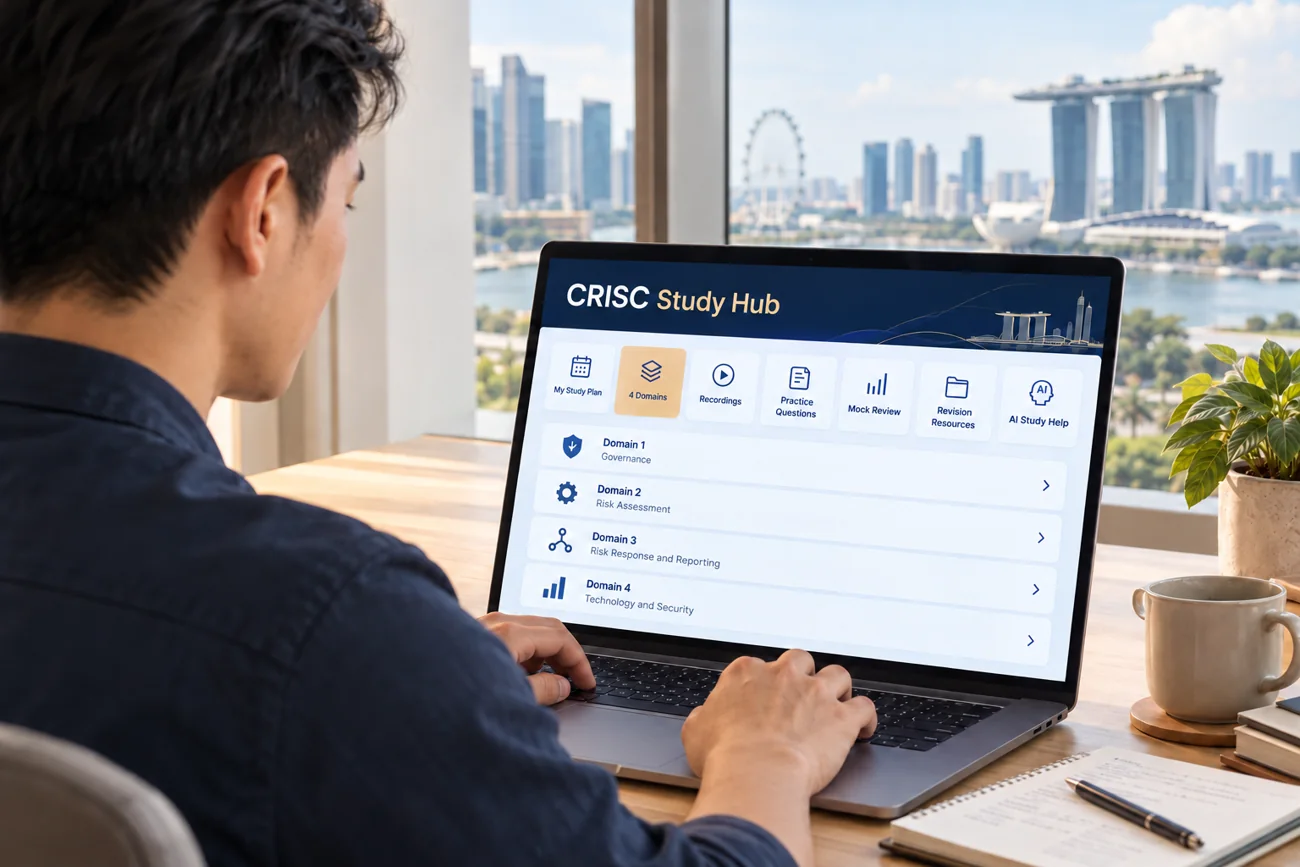
Your classes are backed by a complete study platform. Review recordings, practise questions, track progress and focus revision where you need help.
Revisit lessons and difficult explanations.
Keep track of topics and weaker areas.
Build knowledge and decision-making skills.
Understand mistakes and what to revise next.
Find clear summaries and visual resources.
Clarify concepts and locate useful material.
Mind maps, infographics, revision sheets, checklists, glossary, study planners and many more resources make preparation easier to organise.
Learn
Understand concepts through live teaching, recordings, notes, visual summaries and AI study support.
Practise
Apply what you learn through questions, realistic risk cases, timed tests and multiple mocks.
Improve
Review mistakes with faculty, work on weaker topics and use your personal revision plan to guide the next stage.
CRISC Syllabus and Domain Weights
Our course covers the current ISACA CRISC exam blueprint, effective since 3 November 2025.
| Current domain | Weight | What you learn |
|---|---|---|
| Governance | 26% | Business objectives, ownership, risk appetite and governance |
| Risk Assessment | 22% | Risk scenarios, likelihood and impact, analysis and risk registers |
| Risk Response and Reporting | 32% | Response options, controls, monitoring and management reporting |
| Technology and Security | 20% | Technology operations, resilience, security and emerging risks |
1. Governance: Business Context and Risk Ownership
Connect strategy, business processes, assets, roles and policies with risk management. Understand enterprise risk, lines of defence, risk appetite, tolerance and relevant legal or contractual requirements. Risk appetite describes the level of risk an organisation is willing to accept.
In class: identify who owns a risk and when a decision needs approval or escalation.
2. Risk Assessment: Identify and Analyse Risk
Develop risk scenarios, assess threats and vulnerabilities, consider business impact, and distinguish inherent risk without controls from residual risk after controls. Work with risk-analysis methods and risk registers.
In class: assess a cloud or third-party scenario and explain what evidence changes your assessment.
3. Risk Response and Reporting: Choose and Monitor Controls
Compare treatment options, clarify risk and control ownership, evaluate control design and effectiveness, and manage vendor exposure, issues and exceptions. Use action plans, KRIs, KCIs, KPIs and reporting to track risk.
In class: recommend a proportionate response and explain how management should monitor it.
4. Technology and Security: Understand the Risk Context
Study technology principles, architecture, operations, system development, data, projects, recovery and emerging technology. Connect security, privacy and awareness with business-risk decisions.
In class: distinguish a technical improvement from the best risk-based business response.
Source: ISACA CRISC Exam Content Outline. Older material may show 26% / 20% / 32% / 22%; check that your preparation follows the active 26% / 22% / 32% / 20% blueprint.
Multiple Mocks and Personal Revision Support
CRISC questions test judgement as well as knowledge. We help you understand what the scenario asks, who owns the decision and why one response is stronger.
- Start with diagnostic and topic-level practice.
- Progress to mixed-domain questions and timed tests.
- Complete multiple fresh full mocks using a four-hour exam rhythm.
- Review incorrect answers and close alternatives with faculty.
- Follow up with targeted practice and revision in weaker areas.
Live doubt-clearing, individual feedback and revision support are included. Supported self-paced learners also receive faculty guidance.
What Useful Trainer Feedback Looks Like
Illustrative feedback: “You spotted the control gap, but your answer gives the decision to the wrong person. Identify the accountable risk owner, then consider the response and approval process.”
The next revision focuses on ownership and risk response, rather than simply repeating more questions.
Mock results help guide preparation. They are not a prediction of ISACA’s scaled score.
Choose Your CRISC Study Option
Study in a Singapore classroom, join live online or choose a more personal route. Teaching, practice and support stay central.
| Study option | What to expect |
|---|---|
| Singapore classroom | Face-to-face teaching, discussion and guided question practice |
| Live online | Interactive faculty-led classes, recordings and LMS resources |
| Supported self-paced | Recorded teaching, the full learning platform, practice and live faculty support |
| Private 1:1 | Teaching and revision focused on your background and needs |
| Focused revision | Mock review, question technique and weaker-topic support |
| Corporate cohorts | Private classroom, Singapore onsite, live online or blended programmes |
Our central Singapore teaching venue is at Raffles City Tower. Classroom and corporate arrangements can also be organised elsewhere across Singapore.
Your study plan considers your experience, work commitments, target examination date and practice progress. Ask us about weekday, weekend and flexible arrangements.
Meet Your CRISC Trainers

Kashif Akhtar
CISA | CISM | CRISC | CDPSE | PMP | CSCP | Qualified Engineer
30+ Years in Technology, Cyber Risk, Governance & Enterprise Systems
13+ Years in Professional Certification Training
Kashif connects CRISC concepts with technology-risk decisions across Singapore’s banking, fintech, technology, telecom and regional business environments. He is particularly strong at question judgement: who owns the risk, what should happen next and why the best business response is not always the most technical one.
More About Kashif
Kashif brings more than 30 years of practical experience across enterprise technology, cybersecurity, IT risk, governance and control environments.
His sessions cover risk appetite and tolerance, risk scenarios, inherent and residual risk, KRIs, control design, cloud and third-party risk, cyber resilience, business continuity and executive reporting.
Singapore examples connect the curriculum with regional headquarters, critical infrastructure and MAS technology-risk expectations. He helps candidates choose the right decision for the facts and stage of the question.

Tanvi P.
CISA | CIA | CFE | CAMS
20+ Years in Risk, Assurance, Investigations & Control Remediation
Tanvi brings an assurance and investigations perspective to CRISC. She shows how weak access controls, third-party failures, poor monitoring and ineffective escalation become business risks. Her scenarios help learners evaluate evidence, control effectiveness and management’s response.
More About Tanvi
Former Regional Financial Crime Risk, Standard Chartered; former Vice President, Citi Global Investigations Unit; former KPMG Forensic Services Manager.
Her international experience covers investigations, control failures, governance, regulatory risk and remediation within major financial institutions.
Sessions use cloud providers, outsourced services, privileged access, fraud, data incidents and control breakdowns to explore risk identification, likelihood and impact, root causes, remediation, escalation and reporting.
Try a CRISC-Style Practice Question
Original EduDelphi mock question. Not an actual ISACA exam question.
A Singapore payments company is adopting a cloud service. The vendor has a satisfactory assurance report, but its tested recovery time is six hours while the company’s critical-service target is two. A new subcontractor will also process customer information.
The completed assessment confirms that residual outage risk exceeds the approved tolerance. What is the most appropriate next step for the risk practitioner?
View the Answer and Explanation
B is the strongest answer. The assessment is already complete. The next decision is about responding to the risk through the right owner and approval process.
An assurance report does not resolve the recovery gap. Immediate termination is not automatically proportionate, and an external auditor does not own management’s risk acceptance.
What to practise: separate assessment from response, identify ownership and use the facts rather than a memorised shortcut.
This is the kind of reasoning we develop through guided cases, question explanations and faculty feedback.
CRISC Exam and Certification Requirements
| Exam fact | Current position |
|---|---|
| Questions | 150 multiple-choice questions |
| Time | Four hours |
| Passing score | 450 on ISACA’s 200-800 scaled range |
| Testing | PSI test centre or remote proctoring, subject to current availability |
| Results | Preliminary status after completion; official scores within ten working days |
450 is a scaled score, not a raw percentage. There is no penalty for an incorrect answer, so answer every question.
You Can Take the Exam Before Meeting the Experience Requirement
There is no three-year work-experience requirement simply to sit the CRISC exam. To receive certification, you need three years of qualifying experience across at least two CRISC domains, verified through ISACA’s application process.
CRISC has no experience waivers or substitutions. Qualifying experience must fall within the ten years before your application, and you must apply within five years of passing.
Exam Registration and Scheduling
Registration is continuous. Take the exam within your six-month eligibility period. Appointments are shown up to 90 days ahead, and no-penalty rescheduling is available at least 48 hours before the appointment, within eligibility.
Register through ISACA, then schedule through PSI. Check Singapore test-centre availability or the current remote-testing requirements before choosing a date. We provide registration, study planning and application guidance; ISACA assesses certification eligibility.
Sources: ISACA Exam Candidate Guide and CRISC certification requirements.
CRISC Course Fees in Singapore
Request your SGD quotation for classroom, live online, supported self-paced, private, revision or corporate training.
Your quotation explains the selected route, teaching, LMS resources, recordings, practice, mocks and faculty support. Instalment options are available.
EduDelphi tuition and official ISACA examination charges are separate.
Official ISACA Reference Fees
| Item | Member | Non-member |
|---|---|---|
| CRISC exam | US$575 | US$760 |
| Certification application | US$50 | US$50 |
Checked October 2026. Confirm current charges with ISACA before payment. Membership is not required simply to take the exam.
For employer sponsorship, we can provide a quotation, invoice, syllabus and learning outcomes.
CRISC Skills for Singapore Technology-Risk Roles
Connect risk concepts with work across banking, fintech, regional headquarters, technology, telecom and other organisations that depend on reliable systems.
| Singapore work responsibility | What you practise |
|---|---|
| Cloud and outsourced services | Identify dependencies, evidence gaps and residual risk |
| Critical-service resilience | Relate recovery capability to business needs |
| Technology and cyber governance | Clarify appetite, owners, responses and escalation |
| Third-party risk | Evaluate controls and choose proportionate actions |
| Management reporting | Use useful indicators and explain action priorities |
MAS’s Technology Risk Management Guidelines and operational-resilience framework provide useful local context. Singapore examples support understanding; they do not add requirements to ISACA’s examinable syllabus.
Local references: MAS Technology Risk Management Guidelines and MAS operational resilience.
Career Direction and Support
CRISC learning is relevant to technology-risk, cyber-risk, GRC, controls and risk-advisory roles. For example, EY’s October 2026 Singapore IT Internal Audit Manager listing includes CRISC among desirable certifications.
Included career support: role guidance, CV and LinkedIn review, interview preparation and further professional support. Certification complements experience; employer requirements vary.
Corporate CRISC Training in Singapore
Build a shared approach to technology risk, controls and certification preparation across your team.
- Private CRISC cohorts and team study plans
- Singapore onsite, classroom, live online and blended delivery
- Company-relevant risk and control scenarios
- Questions, multiple mocks and individual faculty feedback
- Progress reviews and focused revision
- Custom schedules and programme coordination
Applied discussions can cover cloud and vendor risk, resilience, control evidence and management reporting alongside qualification preparation.

CRISC vs CISA, CISM and CISSP
Choose the route that matches your work and professional direction. These certifications can complement one another; none is a mandatory step before CRISC.
| Route | Main focus | Choose it when |
|---|---|---|
| CRISC | Information and technology risk, controls and reporting | You assess risk, guide responses and work with accountable owners |
| CISA | Information-systems audit and assurance | You evaluate systems, controls and audit evidence |
| CISM | Information-security management | You lead or manage a security programme |
| CISSP | Broad cybersecurity practice and architecture | You work across security design, implementation and operations |
For an information-security management-system route, explore ISO 27001 Lead Implementer or Lead Auditor training.
Further reading: compare ISACA certification pathways or browse our Singapore cybersecurity and IT-governance courses.
CRISC Course Singapore FAQs
Can I take the CRISC exam without three years of experience?
Yes. You can sit the examination before meeting the certification experience requirement. To receive CRISC certification, you must meet ISACA’s separate work-experience, verification and application requirements.
Are there experience waivers for CRISC?
No. CRISC does not offer experience waivers or substitutions. Certification requires three years of qualifying experience across at least two current domains. CISA’s experience-substitution rules do not apply to CRISC.
How many training hours are included?
The live instructor-led route includes 40 faculty-led training hours. Your wider preparation also includes independent reading, practice, recordings, revision and mocks. We help you build a study plan around your background and progress.
Can I attend classroom training in Singapore?
Yes. We offer Singapore classroom training, live online, private 1:1, supported self-paced, revision and corporate options. Classroom and onsite arrangements can be organised across Singapore.
What is included in the LMS?
The platform includes recordings, 3,000+ practice questions, notes, mind maps, infographics, revision sheets, glossary, study planners, progress tools, AI study support and much more. Questions are separate from the extensive additional learning resources.
Do self-paced learners receive live faculty support?
Yes. Supported self-paced study includes recorded teaching, the LMS, practice and faculty guidance. Live doubt-clearing, mock feedback and revision support help you work through difficult concepts and decisions.
Are the ISACA examination fees separate?
Yes. EduDelphi tuition and official ISACA charges are separate. The current exam reference is US$575 for members and US$760 for non-members. Membership is not compulsory simply to sit the examination.
What happens if I need to retake CRISC?
ISACA currently permits up to four attempts in a rolling twelve-month period. Wait 30 days after the first failed attempt and 90 days after the second and third. Each retake requires a new paid registration. Faculty help you review mistakes and focus your preparation.
How do I maintain CRISC after certification?
Certified holders must report at least 20 CPE hours annually and 120 over three years, follow ISACA’s ethics and maintenance requirements, and pay annual maintenance fees. Current maintenance is US$45 for members and US$85 for non-members. See ISACA’s current policy.
Can my employer sponsor the course?
Yes. We provide course quotations, invoices, syllabuses and learning outcomes for employer-sponsored training. Private company cohorts, custom schedules and Singapore onsite delivery are also available.
Is SkillsFuture funding available?
SkillsFuture Credit can be used for eligible courses under the applicable scheme. Ask us to check the current course listing and your eligibility before relying on funding. We can provide supporting course documents for employer reimbursement and other approved applications.
Check the official SkillsFuture Credit guidance.
What certificate will I receive from EduDelphi?
You receive an EduDelphi Certificate of Training. The professional CRISC certification is awarded separately by ISACA after you pass its examination and meet the certification requirements.
Can you help me choose a study plan?
Yes. Request course details or a personal study plan. We help you consider your starting knowledge, preferred study format, target date and areas to work on, without requiring a long questionnaire before your enquiry.
Official facts checked October 2026. Confirm current examination and certification requirements with ISACA before registration.
Get CRISC Course Details and SGD Fees
Ask about the syllabus, classroom and online options, inclusions, instalments or a personal preparation plan.
4.6/5 rating from 200+ EduDelphi Singapore reviews.
EduDelphi Singapore250 N Bridge Rd, Raffles City Tower
Singapore 179101
Request CRISC Course Details
Leave your name, email and phone number. Our team will help you choose your next step.