AI for Supply Chain Course in Dubai, UAE
Practical AI for Planning, Inventory, Logistics & Resilience
Use AI to improve demand forecasting, inventory decisions, supply planning, S&OP, logistics, exception management and supply-chain resilience through guided, hands-on training.

AI for Supply Chain Course Overview
Learn how AI can support better demand, inventory, supply, S&OP, logistics and resilience decisions without removing human judgement or operational accountability.
This practical, no-code course combines generative AI with Excel, Power Query, dashboards, scenario analysis and carefully reviewed automation. Learners work through connected planning and operations exercises rather than isolated software demonstrations.
- Built for supply-chain, planning, inventory, logistics, warehouse, distribution and operations professionals.
- No coding or previous AI experience required for the standard route.
- Guided exercises using realistic, sanitised supply-chain data.
- LMS access, recordings, templates, practice files and structured learning support.
- Corporate delivery can align with approved tools, planning processes and company scenarios.
What AI Can Help You Do in Supply Chain
Use AI as a reviewed decision-support tool across planning and operations.
Improve demand forecasts
Prepare data, investigate seasonality and promotions, compare scenarios and explain forecast changes.
Review inventory decisions
Analyse segmentation, service levels, safety stock, reorder points and priority exceptions.
Test supply scenarios
Compare capacity, material, labour, lead-time and service trade-offs before making a decision.
Support S&OP and IBP
Turn demand, supply and financial information into a concise management decision brief.
Improve logistics visibility
Review transport, warehouse, distribution and fulfilment exceptions using structured analysis.
Respond to disruption
Monitor signals, assess operational impact and prepare clear resilience and escalation actions.
Who Should Take This Course?
For professionals who plan, move, store or manage the flow of products, materials and information.
Planning teams
Demand planners, supply planners, S&OP and IBP professionals, production planners and operations analysts.
Inventory and materials
Inventory controllers, materials managers, replenishment teams and working-capital professionals.
Logistics and distribution
Logistics, warehouse, transport, fulfilment, distribution and customer-service professionals.
Leaders and transformation teams
Supply-chain managers, operations leaders, consultants, project teams and transformation professionals.
Seven Practical Supply Chain Outputs
Build useful planning resources that connect data, AI assistance, human review and real supply-chain decisions.
Each output has a clear business purpose. Learners check data quality, assumptions, calculations, operational constraints and the point at which a person must review or approve the result.

AI Use-Case & Data-Readiness Matrix
Prioritise use cases by value, feasibility, data needs, risk, owner and success measure.
Demand Forecast Scenario Workbook
Compare a baseline with scenario adjustments, forecast accuracy, bias and planner commentary.
Inventory Exception Dashboard
Segment inventory and focus attention on stockout, excess and service risks.
Supply & Capacity Scenario Pack
Document assumptions, constraints, alternatives, impact and escalation points.
S&OP / IBP Decision Brief
Summarise demand, supply, financial and service implications for management.
Logistics & Disruption Scenario
Assess route, fulfilment or capacity disruption and prepare a response.
Automation & 90-Day Roadmap
Map workflow steps, approved tools, human controls, pilot measures and next steps.
AI for Supply Chain Course Syllabus
Eight connected modules move from sound data and use-case selection to planning, operations, resilience and responsible adoption.
Module 1: AI in Supply Chain, Data Readiness & Use-Case Selection
Understand predictive AI, generative AI, optimisation and automation. Review data sources, history, granularity, quality and confidentiality. Prioritise opportunities by value, feasibility and risk.
- AI capabilities and limits.
- Data-readiness and approved-tool checks.
- Use-case prioritisation and decision ownership.
Module 2: Demand Forecasting & Demand Sensing
Work with baseline forecasts, seasonality, promotions, external signals and exceptions. Measure accuracy and bias, compare scenarios and combine AI support with planner judgement.
- Forecast inputs and data preparation.
- Scenario adjustments and assumptions.
- Accuracy, bias and human validation.
Module 3: Inventory, Service Levels & Working Capital
Review ABC/XYZ segmentation, safety stock, reorder points, stockout risk, excess inventory and service choices. Use AI to identify and explain priority exceptions.
- Inventory-policy choices.
- Service and working-capital trade-offs.
- Exception prioritisation and review.
Module 4: Supply Planning, Capacity & Constraint Scenarios
Translate demand into supply requirements and test material, labour, capacity, lead-time and service constraints. Compare alternatives and define escalation points.
- Demand-to-supply translation.
- Capacity and material constraints.
- What-if scenarios and trade-offs.
Module 5: AI-Supported S&OP & IBP Decisions
Connect demand review, supply review, reconciliation and executive decisions. Present implications for finance, service, capacity and inventory.
- Demand and supply review.
- Scenario reconciliation.
- Management decision communication.
Module 6: Logistics, Warehousing & Distribution
Explore transport, carrier, route, warehouse, labour, picking, fulfilment and distribution use cases. Review where optimisation, computer vision and automation may fit.
- Transport and route decision support.
- Warehouse and fulfilment use cases.
- Distribution exceptions and service risk.
Module 7: Supply-Chain Risk, Resilience & Control-Tower Thinking
Monitor disruption signals, dependencies, bottlenecks and alternate scenarios. Assess operational impact and prepare response priorities, escalation and communication.
- Disruption and dependency signals.
- Operational impact assessment.
- Resilience actions and escalation.
Module 8: Dashboards, Automation, AI Agents & Adoption
Connect analysis, dashboards, workflow steps and human approvals. Examine agents for monitoring and exception routing, then define a responsible pilot and adoption roadmap.
- Dashboard and workflow connections.
- Human-in-the-loop automation.
- KPIs, governance and adoption planning.
Tools Used in the Course
The standard course uses accessible tools for practical decision support. Advanced and corporate routes can adapt to the organisation’s environment.
Planning Inventory for a UAE Distribution Network
A UAE distributor serves several emirates and imports products with long, variable lead times. Demand rises during seasonal periods, inventory is uneven across locations, and one international route is facing disruption.
This is an original EduDelphi teaching scenario, not a claim about a live client project.
Responsible AI and Human Review in Supply Chain
AI can improve analysis and speed, but decisions still need reliable data, operational context and accountable people.
Protect information
Use approved tools and follow data rules for customer, supplier and operational information.
Validate the data
Check completeness, history, units, timing and known gaps before trusting an output.
Review the decision
Test assumptions, calculations, constraints and business impact before action.
Preserve accountability
Keep clear owners, approval points, records and escalation routes.
AI for Supply Chain vs AI for Procurement
Choose the course that matches the decisions you make most often.
| Course | Main focus | Typical work |
|---|---|---|
| AI for Supply Chain | Planning, flow, service and operational decisions | Demand, inventory, supply planning, capacity, S&OP, logistics, distribution and resilience |
| AI for Procurement Course | Buying decisions and supplier relationships | Spend, categories, supplier research, sourcing, RFx, bids, contracts, negotiation and procurement workflows |
AI for Supply Chain Training for Teams
Build a practical programme around the organisation’s planning processes, operating model, approved tools and priority decisions.
- Map workflows across demand, inventory, supply, S&OP, logistics and resilience.
- Adapt labs to company data or realistic sanitised scenarios.
- Align training with approved AI tools, dashboards and planning environments.
- Train by role and build reusable templates, checks and decision workflows.
- Define pilot use cases, measures and follow-up reinforcement.

AI for Supply Chain in UAE Industries
Examples connect global AI methods with the planning and logistics realities of UAE organisations.
Retail, FMCG and e-commerce
Seasonality, promotions, availability, fulfilment and replenishment.
Logistics, ports and aviation
Capacity, routes, international flows, exceptions and visibility.
Manufacturing and industry
Materials, capacity, production constraints and working capital.
Energy and construction
Long lead times, critical materials, project demand and continuity.
Healthcare and pharmaceuticals
Availability, shelf life, regulated products and service risk.
Hospitality and distribution
Volatile demand, service levels and regional distribution.
Established Dubai Training Experience
EduDelphi has delivered professional and AI training for teams from leading organisations.






Selected organisations that have received EduDelphi AI training.
KHDA Certificate for AI for Supply Chain
AI for Supply Chain is a KHDA-approved professional training course in Dubai. Successful learners receive a KHDA course certificate after completing the course requirements.
The certificate records completion of professional training. It does not certify an organisation’s supply chain or award a software-vendor certification.
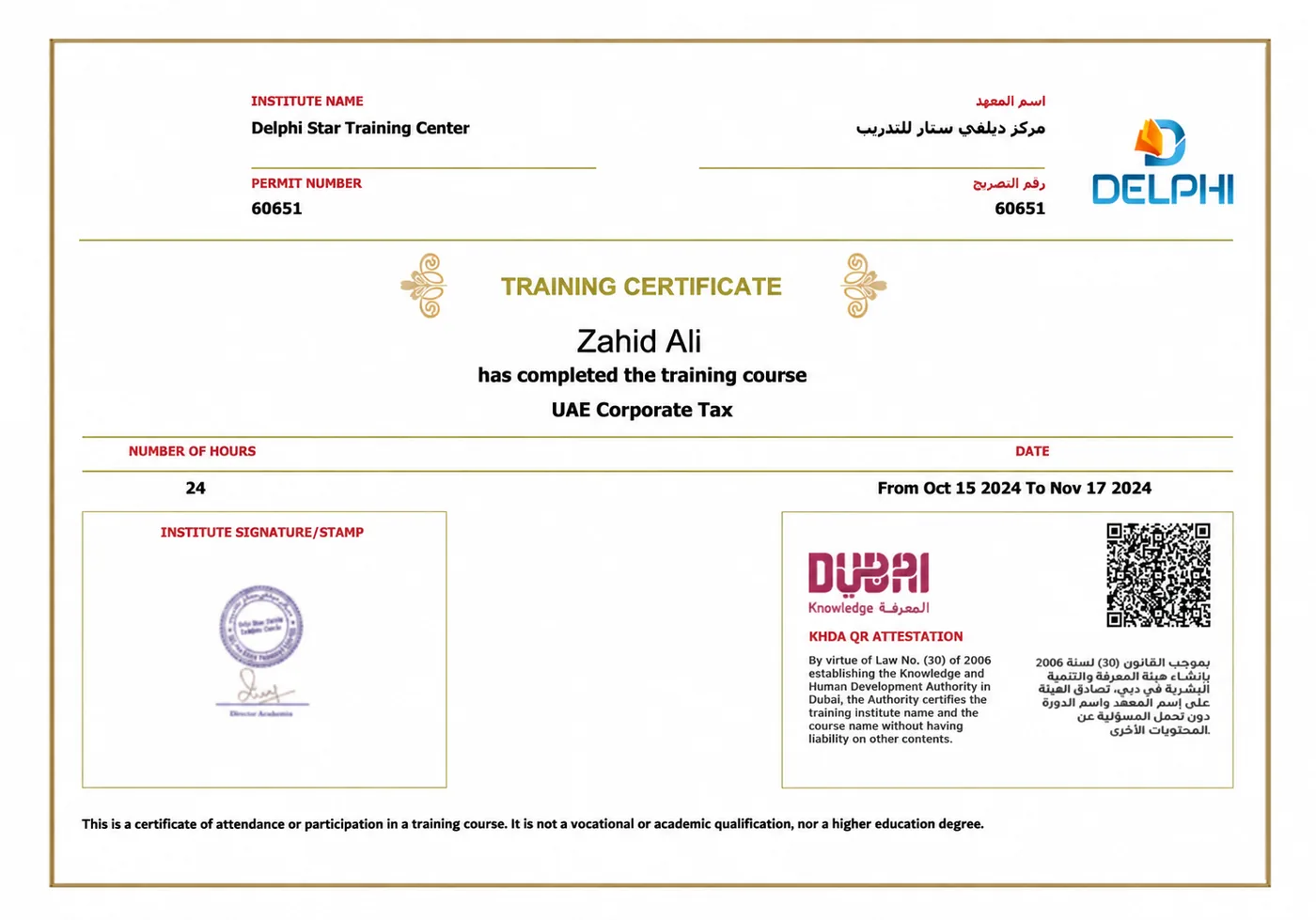
Sample KHDA-attested training certificate format. Learner and course details vary.
Course Fees, Next Batch and Delivery Options
Tuition is enquiry-led. Request the current AED fee, active schedule and written inclusions.
Instructor-led group learning with practical planning exercises.
UAE-friendly interactive delivery with the same guided work.
Focused delivery around your role and priority use cases.
Private onsite, classroom or online learning aligned to your environment.
Related Supply Chain and AI Courses
Choose practical AI training or continue into a specialist supply-chain pathway.
| Course | Best suited to | Main focus |
|---|---|---|
| AI for Supply Chain | Planning, inventory, logistics and operations professionals | Demand, inventory, supply, S&OP, logistics, resilience and automation |
| AI for Procurement | Procurement, sourcing, supplier and contract professionals | Spend, suppliers, sourcing, bids, contracts and negotiation |
| Generative AI Course | Professionals seeking broad workplace AI capability | Research, analysis, prompting and productivity |
| Microsoft Copilot Course | Teams working across Microsoft 365 | Copilot in Excel, Word, PowerPoint, Outlook and Teams |
| CSCP Certification Course | End-to-end supply-chain professionals | ASCM CSCP exam preparation and knowledge |
| CPIM Certification Course | Planning, inventory and operations professionals | ASCM CPIM exam preparation and knowledge |
AI for Supply Chain Training in Dubai and the UAE
Attend the Dubai classroom near BurJuman Metro, join live online anywhere in the UAE, or arrange private and corporate training around your planning processes and approved technology environment.
Evening and weekend schedules are available for working professionals, subject to the current cohort calendar.
EduDelphi Dubai
Delphi Star Training CenterBuilding R308, Office 401
Near BurJuman Metro Exit 3
Dubai, United Arab Emirates
Phone: +971 4 396 3634
Email: [email protected]
Join instructor-led learning at EduDelphi’s Dubai training centre.
Corporate delivery can be arranged at client locations.
Join from Dubai, Abu Dhabi, Sharjah, Ajman, Ras Al Khaimah, Fujairah or Umm Al Quwain.
Frequently Asked Questions
What is the AI for Supply Chain course in Dubai?
It is a 24 guided-hour practical course covering AI-supported demand forecasting, inventory, supply planning, S&OP, logistics, resilience, dashboards, automation and responsible adoption.
Who should attend the course?
It is designed for supply-chain managers and analysts, planners, inventory and materials professionals, S&OP teams, logistics, warehouse and distribution professionals, operations teams and transformation leaders.
Do I need coding or previous AI experience?
No. The standard course is beginner-friendly and does not require coding. Supply-chain or operations experience is useful because exercises use realistic decisions.
Which tools are used?
Core practice uses a leading GenAI assistant with Excel and Power Query. Power BI, Microsoft Copilot and workflow automation are used or demonstrated where relevant.
Does the course cover AI demand forecasting?
Yes. Learners prepare data, review seasonality and promotions, compare scenarios, calculate accuracy and bias, and document where planner judgement is required.
Does the course cover inventory optimisation?
Yes. The course covers inventory segmentation, safety stock and reorder concepts, stockout and excess risk, service trade-offs and AI-supported exception review.
Does the course cover S&OP and IBP?
Yes. A full module connects demand review, supply review, reconciliation and executive decision support. Learners build an S&OP or IBP decision brief.
Does the course cover logistics and warehousing?
Yes. Learners explore transport, route, warehouse, fulfilment and distribution use cases, plus the role of optimisation, automation and human review.
What practical work will I complete?
You will complete seven outputs: a use-case matrix, forecast workbook, inventory dashboard, supply scenario pack, S&OP brief, logistics and disruption scenario, and a 90-day roadmap.
How is this different from AI for Procurement?
AI for Supply Chain focuses on demand, inventory, supply planning, capacity, S&OP, logistics and resilience. AI for Procurement focuses on spend, sourcing, suppliers, RFx, bids, contracts and negotiation.
Can corporate training use our planning process and systems?
Yes. Private programmes can be adapted to your workflows, sanitised datasets, approved AI tools, dashboards, ERP or planning-system context and governance requirements.
Is the course available online across the UAE?
Yes. EduDelphi offers Dubai classroom and live online delivery across the UAE, along with private and corporate formats.
Is AI for Supply Chain a KHDA-approved course?
Yes. It is a KHDA-approved professional training course. Successful learners receive a KHDA course certificate after completing the course requirements.
What are the course fees and next batch dates?
Fees are enquiry-led because delivery routes differ. Request the current AED tuition, written inclusions and active schedule using the form.
Enquire About the AI for Supply Chain Course
Tell us your preferred delivery format and schedule. We will share current AED fees, the syllabus, available batches and private or corporate options.
- 24 guided hours and eight connected modules.
- Seven practical outputs and reusable resources.
- Dubai classroom and live online across the UAE.
- KHDA-approved course and KHDA course certificate.
Get Fees, Syllabus and Next Batch
24 hours | Seven outputs | Classroom and live online