Practical Corporate Tax Training for UAE Work
Build practical UAE Corporate Tax skills through 18+ guided hours of classroom or live-online training covering taxable income, Free Zones, transfer pricing, EmaraTax, return preparation and current FTA requirements.
The programme is suitable for beginners and experienced professionals. Learn through clear explanations, demonstrations, computations and UAE business cases, with recordings provided for every cohort.
Current Dubai Delivery
- 18+ hours of guided practical learning.
- Dubai classroom and UAE-time live online.
- Recordings for every cohort.
- Self-paced, private and one-to-one options.
- KHDA and EduDelphi course-completion certificates.
- No formal prerequisites and no final exam.
- Fees and batch dates provided on enquiry.
UAE Corporate Tax Course in Dubai
Review the course structure, delivery and practical inclusions before choosing your batch.

What Is UAE Corporate Tax?
UAE Corporate Tax is a federal tax on the taxable income of businesses and certain persons. The core framework is established by Federal Decree-Law No. 47 of 2022, as amended, with administration and guidance provided through the Federal Tax Authority.
General rate structure
For most taxable persons, the headline structure is 0% on taxable income up to AED 375,000 and 9% above that threshold. Specific rules apply to Free Zone businesses and large multinational groups.
Accounting is the starting point
Corporate Tax normally starts from accounting income, followed by tax adjustments, exemptions, deductions, reliefs and other rules supported by suitable records.
Natural persons can be in scope
Corporate Tax can apply to a natural person conducting a Business or Business Activity in the UAE when annual turnover from those activities exceeds AED 1 million. Wages, personal investment income and real-estate investment income are generally excluded from that threshold calculation.
Compliance is an annual process
Businesses need to consider registration, records, financial statements, return preparation, payment, related-party reporting and evidence readiness across the tax period.
UAE Corporate Tax 2026: Current Rules Finance Teams Need to Watch
The course follows current Ministry of Finance, FTA and UAE legislation sources and updates the learning when material rules or procedures change.
Current filing cycle
Corporate Tax returns and tax due are generally required within nine months after the end of the Tax Period. A business with a 31 December 2025 year-end generally has until 30 September 2026 to file and pay.
Small Business Relief
Eligible Resident Persons with revenue of AED 3 million or less in the current and all previous relevant Tax Periods may elect Small Business Relief, subject to the detailed conditions. The current framework applies to Tax Periods ending on or before 31 December 2026, and eligible businesses still file simplified returns.
Free Zone distributor compliance
FTA Decision No. 6 of 2026 introduces additional procedures for certain QFZPs conducting distribution of goods or materials in or from a Designated Zone, including an independent agreed-upon procedures report. It does not apply to every QFZP.
R&D tax incentive
Phase 1 of the UAE R&D incentive launched in March 2026. It provides an eligible non-refundable tax credit of up to 50% on qualifying R&D expenditure of up to AED 5 million, subject to the detailed conditions.
UAE Corporate Tax Computation & EmaraTax Return Practice
Follow the practical workflow from accounting records to a reviewed return.
- Read a fictional trial balance and management accounts.
- Separate accounting entries from Corporate Tax adjustments.
- Review deductible and non-deductible expenditure.
- Prepare supporting schedules and an accounting-to-tax reconciliation.
- Follow a trainer-led EmaraTax registration and return workflow.
- Check documents, responsibilities and filing readiness before submission.
Demonstrations use training data. EduDelphi does not submit a learner’s or employer’s live return during class.

What You Will Learn in UAE Corporate Tax Training
Classify the tax position
Identify taxable-person, exempt-person, mainland, Free Zone and other scope questions before starting a computation.
Build a tax computation
Move from accounting profit to taxable income using structured adjustments and supporting schedules.
Review Free Zone conditions
Assess QFZP and qualifying-income questions without assuming every Free Zone entity automatically receives 0% treatment.
Recognise related-party risk
Identify connected-person and transfer-pricing issues that require evidence, analysis or escalation.
Prepare for EmaraTax workflows
Understand registration, return preparation, document checks, payment and annual compliance planning.
Improve FTA readiness
Organise records, reconciliations, ownership, review controls and response files more clearly.
Who Should Take This UAE Corporate Tax Course?
- Accountants, senior accountants and finance managers.
- Tax executives, consultants and advisory professionals.
- Auditors, internal auditors and compliance teams.
- Business owners, founders and SME finance teams.
- Free Zone finance, operations and corporate-services professionals.
- CA, ACCA, CPA, CMA and commerce learners building UAE tax capability.
- Professionals moving into UAE tax, reporting or finance roles.
- Corporate teams preparing for recurring tax-compliance work.
Beginner-friendly, then progressively practical
No formal prerequisites are required. The course begins with core terms and the federal framework before moving into computations, Free Zone cases, transfer-pricing awareness, EmaraTax and return readiness.
Basic familiarity with accounting or financial statements is useful but not mandatory. Learners who need extra reinforcement can use the recordings supplied with every cohort.
UAE Corporate Tax Course Syllabus: 10 Practical Modules
The syllabus moves from the legal framework and entity scope into computation, Free Zones, reliefs, transfer pricing, EmaraTax and FTA readiness.
1. UAE Corporate Tax Law, Authorities & Current Framework
Federal Decree-Law No. 47 of 2022 as amended, the roles of the Ministry of Finance and Federal Tax Authority, effective tax periods, key definitions, current official guidance and the relationship between accounting records and Corporate Tax obligations.
Practical exercise: Classify a set of UAE business scenarios and identify the official source needed for each decision.
Learner output: Corporate Tax scope and source-checking map.
2. Taxable Persons, Exempt Persons & Business Presence
Resident and non-resident persons, juridical persons, natural persons conducting business, permanent-establishment awareness, exempt-person categories, branches and when registration, return or recordkeeping questions arise. For natural persons, the course explains the AED 1 million calendar-year turnover threshold for UAE Business or Business Activities and the general exclusions for wages, personal investment income and real-estate investment income.
Practical exercise: Work through mainland, branch, individual-business and foreign-company examples.
Learner output: Taxable-person classification worksheet.
3. Rates, Thresholds & Small Business Relief
Cover the general 0% and 9% rate structure, the AED 375,000 taxable-income threshold, and Small Business Relief for eligible Resident Persons with revenue not exceeding AED 3 million in the current and all previous relevant Tax Periods. Understand why revenue is not taxable income, when an election is required, who cannot claim the relief, and why eligible businesses still file. The current SBR framework applies to Tax Periods ending on or before 31 December 2026.
Practical exercise: Compare the position of a small business, a growing company and an entity that may not meet relief conditions.
Learner output: Rates, thresholds and relief decision sheet.
4. Accounting Profit to Taxable Income
Start with financial statements and accounting profit, then work through exempt income, deductible and non-deductible expenditure, interest-limitation awareness, entertainment expenditure, depreciation and tax adjustments, provisions, losses and supporting schedules.
Practical exercise: Build and review a UAE Corporate Tax computation from a fictional trial balance and adjustment pack.
Learner output: Accounting-to-tax reconciliation workbook.
5. Free Zone Corporate Tax & Qualifying Income
Free Zone Persons, Qualifying Free Zone Persons, qualifying income, excluded activities, the de minimis test, adequate substance, QFZP audited-financial-statement requirements, mainland transactions and the consequences of failing relevant conditions. The de minimis test generally limits non-qualifying Revenue to the lower of AED 5 million or 5% of relevant total Revenue. A 2026 update introduces additional AUP-report procedures for certain QFZP distribution activities in or from a Designated Zone; it does not apply to every QFZP.
Practical exercise: Map the income streams and risk areas of a Dubai Free Zone company with mixed customers and activities.
Learner output: QFZP conditions and qualifying-income review.
6. Tax Groups, Reliefs, Losses & Restructuring
Tax-group conditions, transfers within a qualifying group, business restructuring relief, participation-exemption awareness, tax losses, ownership and continuity considerations, and the records required to support a chosen treatment.
Practical exercise: Assess a fictional group reorganisation and identify which facts require deeper review.
Learner output: Relief and group-readiness checklist.
7. Related Parties, Connected Persons & Transfer Pricing
Learn when a transaction involves a Related Party or Connected Person, how the arm’s-length principle affects pricing and evidence, and how Corporate Tax return disclosures bring related-party activity into annual compliance. Current return guidance includes a Connected Persons Schedule trigger where aggregate transactions exceed AED 500,000, followed by per-person reporting conditions.
Practical exercise: Review management fees, owner remuneration and intercompany service transactions for risk and missing support.
Learner output: Related-party register and transfer-pricing readiness checklist.
8. EmaraTax Registration, Returns, Payments & Records
Ordinary Corporate Tax registration and deregistration workflows, documents and deadlines, EmaraTax navigation demonstration, return-preparation sequence, payment, record retention, financial-statement readiness and a practical annual compliance calendar. The course distinguishes these workflows from specialist Top-up Tax registration requirements for large in-scope multinational groups.
Practical exercise: Follow a registration-to-return workflow and perform a pre-filing document check.
Learner output: EmaraTax workflow and return-readiness pack.
9. Penalties, FTA Reviews, Notices & Disputes
Administrative-penalty awareness, voluntary disclosure, FTA information requests and audits, reconsideration and dispute-route awareness, evidence files, tax-procedure updates and internal escalation controls.
Practical exercise: Organise a response file for a fictional FTA information request and identify missing evidence.
Learner output: FTA notice-response and tax-risk control framework.
10. UAE Corporate Tax Capstone & 2026 Awareness
Combine scope, computation, Free Zone, relief, related-party, registration, filing and recordkeeping decisions in realistic mainland, Free Zone, SME and group cases. Current topics such as DMTT/Pillar Two and R&D incentives are covered at an appropriate awareness level.
Practical exercise: Complete an end-to-end Corporate Tax readiness review for a fictional UAE business.
Learner output: Corporate Tax action plan and capstone workbook.
Practical UAE Corporate Tax Toolkit
Use structured templates during the course and adapt the methods to your own approved workplace processes after training.
- Taxable-person classification worksheet.
- Mainland versus Free Zone review sheet.
- Accounting-profit-to-taxable-income workbook.
- Deductible-expense review checklist.
- QFZP conditions and qualifying-income map.
- Related-party and connected-person register.
- Transfer-pricing readiness checklist.
- Registration-document checklist.
- EmaraTax workflow guide.
- Return-readiness checklist.
- Annual Corporate Tax calendar.
- Record-retention checklist.
- FTA notice-response framework.
- Tax-risk and internal-control register.

Free Zone Corporate Tax Training
Learn why operating from a Free Zone does not by itself settle the Corporate Tax position.
- Free Zone Person versus Qualifying Free Zone Person.
- Qualifying Income and Excluded Activities.
- Transactions with mainland and overseas customers.
- De minimis test: the lower of AED 5 million or 5% of relevant total Revenue.
- Adequate substance and QFZP audited-financial-statement requirements.
- 2026 AUP-report procedures for certain Designated Zone distributors.
- Elections, records, evidence and risks when activities change.
Cases use realistic Dubai Free Zone environments such as DMCC, JAFZA and DAFZA. The course does not imply that a particular zone or licence automatically receives 0%; treatment depends on the entity’s activities, income, evidence and current Corporate Tax rules.

KHDA-Approved Course and Certificate Proof
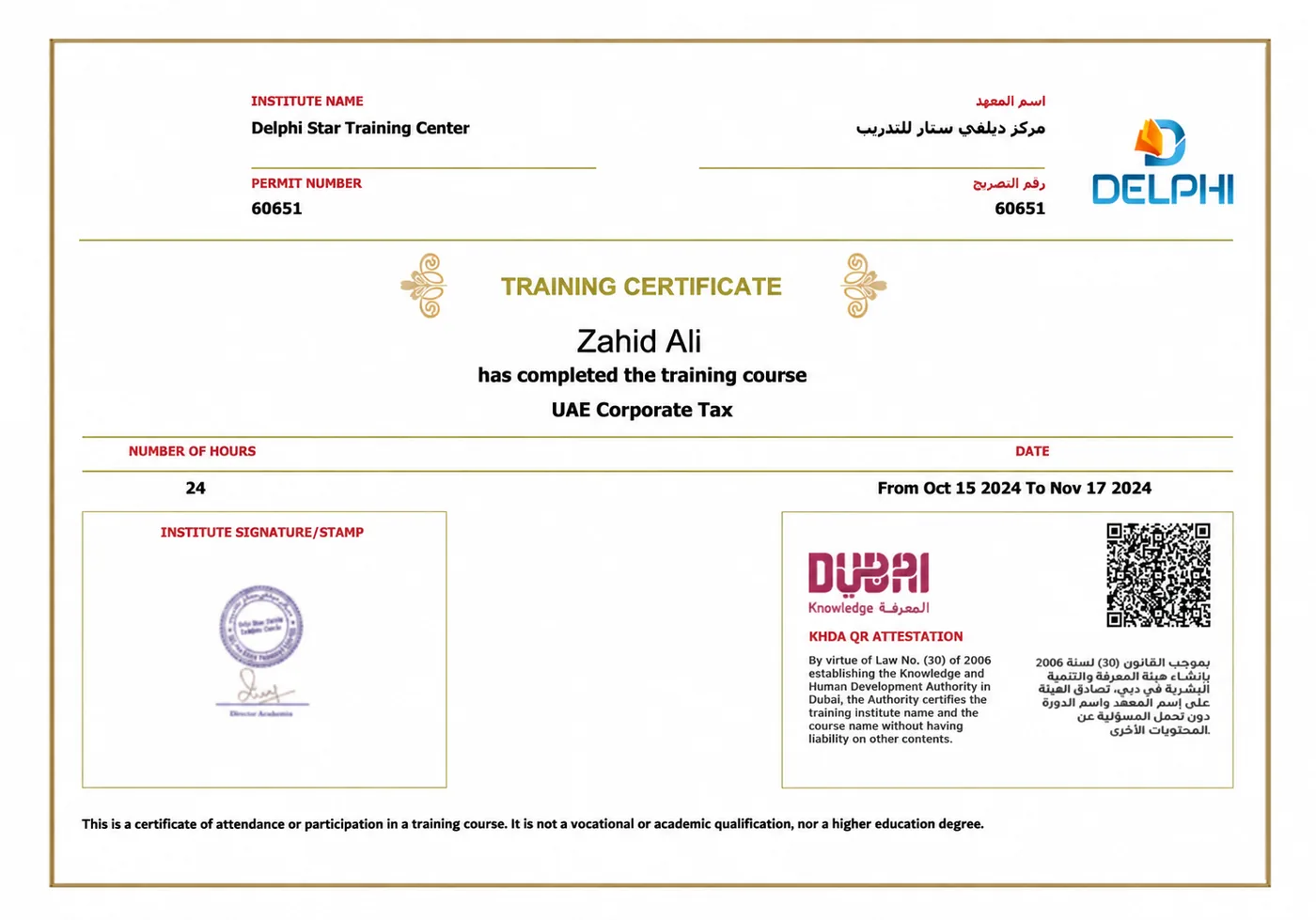
EduDelphi delivers this KHDA-approved UAE Corporate Tax course through Delphi Star Training Center, a KHDA-approved training institute in Dubai.
Learners who meet the applicable completion requirements receive a KHDA course-completion certificate and an EduDelphi UAE Corporate Tax course-completion certificate.
These are professional training-completion documents, not an academic degree, an FTA Tax Agent licence or authorisation to provide regulated advice.
What completion reflects
- Participation in the applicable training route.
- Completion of the required learning activities.
- Coverage of the published UAE Corporate Tax syllabus.
- Professional-development evidence for CV, LinkedIn and employer records.
UAE Corporate Tax Classroom, Online and Self-Paced Training
Dubai classroom
Attend trainer-led sessions in Mankhool near BurJuman Metro with direct interaction, cases and practical demonstrations.
Live online
Join in UAE time from any Emirate with the same live teaching, questions, demonstrations and practical course structure.
Self-paced reinforcement
Use structured resources and recordings to revisit the learning. Ask about the active self-paced route and support available.
Private and one-to-one
Discuss a focused schedule when individual pacing, confidentiality or role-specific emphasis matters.
Weekday and weekend
Request current weekday, evening, weekend and fast-track availability rather than relying on a stale public calendar.
Recordings included
Every cohort includes recordings for revision, catch-up and reinforcement after the live session.
Meet Your UAE Corporate Tax Trainers

CA Shyam Sarrof
CPA (USA), CMA (USA), ACA, ACMA, CS, CFA, ACTM, MBA, B.Com (H)
22+ years of UAE tax, finance, compliance and advisory experience
Shyam supports 100+ UAE client organisations across tax, finance, controls and compliance. His work spans Corporate Tax registration, taxable-income computation, accounting-to-tax reconciliation, Free Zone reviews, related-party matters, transfer-pricing considerations, returns and FTA readiness.
He connects trial balances and financial statements to practical tax adjustments, EmaraTax workflows and filing decisions for mainland businesses, Free Zone entities, SMEs and corporate groups.

Avijit Goswami
CPA (USA), CMA (USA), FCS, FCMA, LLB, CFA, M.Com
Senior Corporate Tax, Financial Reporting and Compliance Faculty
Avijit combines accounting, finance, legal interpretation and compliance review experience. He focuses on taxable-income computation, accounting-to-tax adjustments, reliefs, deductible expenditure, tax losses, related and connected persons, Free Zone questions and return documentation.
Learners work through trial balances, adjustment schedules and case computations to connect the legislation with the records behind the return, identify inconsistencies and improve filing-quality review.
Build UAE Corporate Tax Skills for Finance and Tax Roles
The course can strengthen an existing finance, accounting, audit or compliance profile and help learners explain practical UAE Corporate Tax capability more clearly.
CV and LinkedIn
Present relevant computation, Free Zone, EmaraTax and compliance skills accurately without overstating course completion as professional licensing.
Interview preparation
Practise explaining taxable-income adjustments, QFZP questions, related-party risk and filing-readiness decisions.
Job-search guidance
Receive placement-oriented support and direction appropriate to your background, experience and target UAE roles.
UAE Corporate Tax Course and Institute Reviews
EduDelphi has a 4.6/5 institute-wide Google rating from 200+ reviews. The first review below specifically discusses UAE Corporate Tax and VAT training.
“It’s an extensive exploration of VAT and Corporate Taxes in the UAE, covering all the major components with thoroughness and clarity. Through this course, I gained a comprehensive understanding of the intricate procedures involved in tax filing and processing.”
Veena Shibu
“Excellent Place with Top Notch Experts & Services.”
Syed Nadeem Abidi
“I am satisfied with Delphi’s training course and the fees are reasonable. Highly recommended!”
Lemuel Quider
Which UAE Corporate Tax Learning Route Should You Choose?
| Route | Usually best when | What it provides |
|---|---|---|
| FTA self-study resources | You want official introductory references and can structure your own study. | Authoritative guidance without a dedicated trainer, personalised feedback or guided capstone. |
| EduDelphi 18+ hour practical course | You want live explanation, computation, Free Zone cases, EmaraTax demonstrations and workplace tools. | Guided classroom or online learning, recordings, practical outputs and course-completion certificates. |
| Extended professional diploma | You want a longer, higher-cost academic or professional assessment route. | Broader study hours and a separate assessment structure defined by that provider or awarding route. |
| UAE Tax Agent route | Your goal is formal registration as a Tax Agent. | Separate official eligibility, examination, experience, registration and continuing-obligation requirements. |
UAE Corporate Tax vs VAT: Which Course Do You Need?
Corporate Tax and VAT affect different transactions, records and returns. Choose the course that matches the work you need to perform.
| UAE Corporate Tax | UAE VAT |
|---|---|
| Tax on taxable business income | Tax on supplies and consumption |
| Annual Corporate Tax return | VAT returns at the applicable intervals |
| Accounting profit followed by tax adjustments | Output VAT, input VAT and recoverability |
| Free Zone Corporate Tax and QFZP rules | Designated Zone VAT rules |
| Related parties and transfer pricing | Tax invoices and input-tax evidence |
| Taxable-income computation and reliefs | VAT return computation and adjustments |
Dubai Classroom Near BurJuman Metro
Attend in Mankhool or join live online from anywhere in the UAE.
Delphi Star Training Center
Building R308, Office 401
Mankhool, near BurJuman Metro Exit 3
Dubai, United Arab Emirates
+971 4 396 3634
The centre is approximately a three-minute walk from BurJuman Metro. Ask our team for current classroom access and parking guidance.

Corporate UAE Corporate Tax Training
Build a common Corporate Tax process across finance, accounting, tax, audit, compliance and management teams.
- Training-needs discussion and role mapping.
- Standard programme or customised topic emphasis.
- Approved or anonymised company cases and data where appropriate.
- Mainland, Free Zone, group and industry-relevant scenarios.
- Computation, related-party, filing and documentation workshops.
- Onsite, hotel, EduDelphi premises or live-online delivery.
- Private cohorts and management learning summaries.

UAE Corporate Tax Course Fees, Next Batch & What’s Included
18+ guided hours
Live teaching, demonstrations, computations, case work, questions and practical reinforcement.
Recordings and resources
Recordings for every cohort plus structured notes, worksheets, checklists and practical templates.
Certificates
KHDA and EduDelphi course-completion certificates, subject to the applicable completion requirements.
Fees and live batch dates remain enquiry-led so the team can provide the current classroom, online, private, self-paced or corporate option in AED.
Use the Global Online UAE Corporate Tax Course
Professionals and international teams planning a primarily online learning route can use the broader global page for remote-delivery information. Dubai classroom and UAE-local enquiries should remain on this page.
UAE Corporate Tax Course FAQs
What does the UAE Corporate Tax course in Dubai cover?
The course covers the current UAE Corporate Tax framework, taxable and exempt persons, rates, Small Business Relief, taxable-income computation, Free Zone rules, reliefs, tax groups, related parties, transfer pricing, EmaraTax, returns, records, penalties and FTA readiness.
How long is the UAE Corporate Tax course?
The current programme provides 18+ guided hours of live teaching, demonstrations, practical computation, case work and structured reinforcement.
Is this UAE Corporate Tax course suitable for beginners?
Yes. There are no formal prerequisites. The course starts with the framework and terminology before progressing into computations, Free Zone cases, EmaraTax and return-readiness work.
Is the course available in a Dubai classroom and live online?
Yes. You can join classroom training in Dubai or UAE-time live online sessions. Private, one-to-one, self-paced and corporate options are also available.
Are class recordings provided?
Yes. Recordings are provided for every cohort so learners can revise difficult topics and revisit demonstrations.
Is the UAE Corporate Tax course KHDA approved?
Yes. The course and Delphi Star Training Center are KHDA approved. Applicable course-completion and certificate conditions are confirmed before enrolment.
What certificates do learners receive?
Learners who meet the applicable completion requirements receive a KHDA course-completion certificate and an EduDelphi UAE Corporate Tax course-completion certificate.
Does the course include a final exam?
No. This is a practical professional training course without a final examination. Learning is reinforced through demonstrations, worked cases, computations, discussion and practical outputs.
Will I learn UAE Corporate Tax computation?
Yes. Learners practise moving from accounting profit to taxable income, reviewing adjustments, classifying expenses and preparing supporting schedules for a fictional UAE business.
How is UAE Corporate Tax calculated?
UAE Corporate Tax generally starts from accounting income, which is adjusted under the Corporate Tax Law to determine taxable income. For most taxable persons, taxable income up to AED 375,000 is subject to 0%, while taxable income above AED 375,000 is generally subject to 9%. Special rules apply in areas such as Free Zones and large multinational groups.
When is the UAE Corporate Tax return due?
A Corporate Tax return and any tax due are generally required within nine months after the end of the relevant Tax Period. For example, a taxable person with a financial year ending 31 December 2025 generally has until 30 September 2026 to file and pay.
Does every UAE company pay 9% Corporate Tax?
No. The general 9% rate applies to taxable income above AED 375,000 for most taxable persons. QFZPs have a separate qualifying-income framework, Small Business Relief may apply to eligible businesses, and exemptions or reliefs can affect the result.
Does the course cover Free Zone Corporate Tax?
Yes. The syllabus covers Free Zone Persons, Qualifying Free Zone Persons, Qualifying Income, Excluded Activities, de minimis, substance, audited financial statements, mainland interaction, supporting evidence and current 2026 procedures for certain Designated Zone distributors.
Does a Free Zone company automatically pay 0% Corporate Tax?
No. A Free Zone entity must meet all conditions to qualify as a QFZP, and 0% applies to Qualifying Income. Non-qualifying taxable income is generally subject to 9%, while Free Zone Persons continue to have Corporate Tax registration and filing obligations.
Does Small Business Relief mean no Corporate Tax filing?
No. Eligible businesses must elect Small Business Relief in their return and continue to meet registration, simplified filing and recordkeeping requirements. The current relief framework applies to Tax Periods ending on or before 31 December 2026.
Does the course demonstrate EmaraTax?
Yes. The trainer demonstrates practical registration and return workflows, required information, document checks and filing-readiness logic. The course does not submit a learner’s or employer’s live tax return.
Does the course cover transfer pricing?
Yes. It covers the arm’s-length principle, related and connected persons, common transaction risks, documentation awareness and practical readiness checks.
Should I take the UAE Corporate Tax course or a UAE VAT course first?
Choose the course that matches the work you need to perform. UAE Corporate Tax focuses on taxable business income, accounting-to-tax adjustments, Free Zone conditions, Corporate Tax returns and EmaraTax. UAE VAT focuses on supplies, tax invoices, input tax, output tax and VAT returns. If your role covers both, start with the most urgent compliance responsibility and use the other route to broaden your capability.
Explore the UAE VAT Course online or explore the Advanced UAE VAT Course online.
Are DMTT, Pillar Two and R&D tax incentives included?
They are covered as current awareness topics so learners can recognise when they may be relevant. An 18+ hour practical course does not replace specialist advice or a dedicated advanced international-tax programme.
How can I get UAE Corporate Tax course fees and batch dates?
Use the enquiry form to request current AED fees, payment options and available weekday, evening, weekend, fast-track, private or corporate schedules.
Does this course make me an FTA Tax Agent?
No. Completing this course does not register you as an FTA Tax Agent. Tax Agent registration is a separate regulated pathway administered by the Federal Tax Authority, with its own education, experience, language, prescribed training and examination, insurance and registration requirements.
Do you provide corporate UAE Corporate Tax training?
Yes. Corporate delivery can be arranged at EduDelphi premises, company offices, hotels or live online, with approved or anonymised company cases where appropriate.
Can learners join from Abu Dhabi, Sharjah or another Emirate?
Yes. Live online training supports learners across Abu Dhabi, Sharjah, Ajman, Ras Al Khaimah, Fujairah and Umm Al Quwain, alongside the Dubai classroom option.
Is the course tax or legal advice?
No. The course provides professional education using fictional and approved learning cases. Entity-specific positions should be checked against current law, FTA guidance and appropriately qualified advice.
Plan Your UAE Corporate Tax Training
Tell us your location, preferred learning mode and schedule. We will share the current AED fees, detailed syllabus, available batches and private or corporate options.
Course delivery and certificate conditions are confirmed before enrolment.