Learn UAE Corporate Tax Through Real Workflows
Build practical UAE Corporate Tax capability through 18+ guided hours covering taxable income, Free Zones, transfer pricing, EmaraTax, return preparation and current FTA requirements.
Choose live online, standalone self-paced, private or corporate training. The course is suitable for beginners and experienced professionals, with recordings supplied for every live cohort.
Current Online Course
- 18+ hours of guided practical learning.
- Live online and standalone self-paced routes.
- Recordings for every live cohort.
- Private, one-to-one and corporate options.
- KHDA and EduDelphi course-completion certificates.
- No formal prerequisites and no final exam.
- Fees and schedules provided on enquiry.
UAE Corporate Tax Course Online
Review the content, learning routes and practical work before choosing your course.

How UAE Corporate Tax Works
The UAE applies a federal Corporate Tax framework under Federal Decree-Law No. 47 of 2022, as amended. The course explains how that framework connects to accounting records, tax adjustments, returns and supporting evidence.
Determine who is in scope
Start by distinguishing resident and non-resident juridical persons, exempt persons, Free Zone Persons and natural persons carrying on a UAE Business or Business Activity.
Start from the accounts
Use accounting income as the base, then examine adjustments, exemptions, deductions, reliefs, losses and other provisions that affect taxable income.
Apply the relevant rate or treatment
Understand the general 0% and 9% structure, the AED 375,000 taxable-income threshold and the separate conditions that can affect Free Zone entities or large multinational groups.
Complete the annual compliance cycle
Connect registration, financial information, computation, return preparation, payment, records and responses to the Federal Tax Authority.
UAE Corporate Tax Rules Covered in the 2026 Course
Online materials are reviewed against current Ministry of Finance, FTA and UAE legislative sources. Material changes are incorporated into the relevant lesson rather than added as disconnected news.
Return and payment deadlines
The standard deadline is generally nine months after the end of the Tax Period. For a 31 December 2025 year-end, that ordinarily means filing and payment by 30 September 2026.
Small Business Relief
Learn the AED 3 million Revenue condition, relevant exclusions, election process and continuing filing duties. The current relief framework applies to Tax Periods ending on or before 31 December 2026.
Designated Zone distribution
FTA Decision No. 6 of 2026 adds procedures for certain QFZPs distributing goods or materials in or from a Designated Zone, including an independent AUP report. The requirement is not universal to all QFZPs.
Research and development incentive
The course introduces the March 2026 Phase 1 incentive: an eligible non-refundable credit of up to 50% on qualifying R&D expenditure of up to AED 5 million, subject to the detailed rules.
Live Online, Self-Paced, Private and Corporate Training
Select the format that matches your schedule, support needs and learning goal.
Live online
Join scheduled trainer-led classes with explanations, actual EmaraTax demonstrations, questions, computation practice and feedback. Recordings are provided for every live cohort.
Standalone self-paced
Study through recorded learning, notes, cases, templates, practice questions and applicable trainer-support channels around your own schedule.
Private and one-to-one
Use a focused learning schedule with individual pacing, direct trainer access and role-relevant emphasis.
Corporate training
Arrange private team delivery with sector-relevant cases, tailored topic emphasis, attendance reporting and practical workshops.
Practical Skills You Build in the Online Course
Scope a Corporate Tax case
Identify the entity, activity, Tax Period, available records and questions that must be resolved before calculation begins.
Reconcile accounting and tax
Translate a trial balance or financial statements into an accounting-to-tax adjustment schedule and taxable-income computation.
Test QFZP conditions
Work through Qualifying Income, Excluded Activities, de minimis, substance, audit and evidence requirements for a fictional Free Zone entity.
Map related-party transactions
Recognise Related Party and Connected Person issues, apply arm’s-length reasoning and organise the information needed for review.
Navigate the return process
Follow the flow from registration and supporting schedules to EmaraTax return fields, payment and annual compliance tracking.
Prepare an FTA-ready file
Build clearer reconciliations, source notes, evidence lists, reviewer checks and response records around the tax position.
Who Is the Online UAE Corporate Tax Course For?
- Accountants and finance professionals responsible for UAE entities.
- Tax, audit, compliance and business-advisory teams.
- Shared-services teams handling UAE accounting or reporting work.
- Free Zone finance and corporate-services professionals.
- Owners, founders and managers who review tax work.
- CA, ACCA, CPA, CMA and commerce learners entering UAE taxation.
- Professionals preparing for UAE-facing finance or tax roles.
- Employers seeking a consistent Corporate Tax process across a team.
No formal prerequisite
Beginners can start with the legislation, terminology and accounting connection. Learners with existing finance or tax experience can focus more deeply on computations, QFZP decisions, related parties, EmaraTax and review controls.
Live learners receive recordings for revision. A separate self-paced route is available for those who need to study around their own schedule.
Online UAE Corporate Tax Course Syllabus: 10 Modules
The programme progresses from scope and accounting records to computation, specialist areas, EmaraTax and a complete UAE business case.
1. Corporate Tax Law, Authorities and Source Checking
Understand Federal Decree-Law No. 47 of 2022 as amended, the roles of the Ministry of Finance and FTA, core terms, Tax Periods and how to find the current official rule before reaching a conclusion.
Online workshop: match fictional business questions to the correct legislative or FTA source.
Output: law-and-guidance reference map.
2. Persons, Exemptions and UAE Business Scope
Examine resident and non-resident persons, juridical and natural persons, branches, permanent-establishment awareness, exempt-person categories and the registrations or records each case may require.
Online workshop: classify a company, branch, owner-operated business and foreign business scenario.
Output: scope and person-classification sheet.
3. Tax Rates, Thresholds and Small Business Relief
Apply the general 0%/9% framework and AED 375,000 taxable-income threshold. Distinguish Revenue from taxable income and test the AED 3 million Small Business Relief condition, exclusions, election and filing implications.
Online workshop: compare three businesses with different Revenue, income and eligibility facts.
Output: rate and relief decision record.
4. Financial Statements and Taxable-Income Computation
Move from accounting income into exempt income, deductions, non-deductible costs, interest and entertainment limitations, depreciation-related adjustments, provisions, losses and reconciliation schedules.
Online workshop: prepare a computation from a fictional trial balance and adjustment file.
Output: accounting-to-tax reconciliation.
5. Free Zone Persons, QFZPs and Qualifying Income
Study Qualifying Free Zone Person conditions, Qualifying Income, Excluded Activities, mainland dealings, de minimis, adequate substance, audited statements and the consequences of failing a condition.
Online workshop: review a mixed-income Free Zone case without assuming that a licence guarantees 0%.
Output: QFZP review file.
6. Losses, Reliefs, Groups and Business Changes
Cover tax losses, Tax Groups, qualifying-group transfers, business-restructuring relief, participation-exemption awareness, ownership conditions and the evidence supporting a relief claim.
Online workshop: identify available routes and unresolved facts in a group restructuring case.
Output: relief and group-actions checklist.
7. Transfer Pricing, Related Parties and Connected Persons
Map controlled transactions, apply the arm’s-length principle, review owner and management payments, understand disclosure questions and organise documentation for annual compliance.
Online workshop: examine service fees, intercompany charges and Connected Person remuneration.
Output: transaction register and review notes.
8. Registration, EmaraTax Return and Payment Workflow
Follow ordinary Corporate Tax registration, deregistration, return preparation, return fields, payment, financial information, records and deadline tracking. Specialist Top-up Tax registration is kept separate.
Online workshop: complete a trainer-led registration-to-return walkthrough and document check.
Output: return workflow and filing calendar.
9. FTA Reviews, Penalties and Response Preparation
Learn administrative-penalty awareness, voluntary disclosure, FTA information requests, audit and dispute-route awareness, document control and escalation responsibilities.
Online workshop: assemble a response pack for a simulated FTA request.
Output: evidence index and response plan.
10. Integrated UAE Corporate Tax Case and Current Topics
Bring together scope, taxable income, Free Zone analysis, reliefs, related parties, return preparation and recordkeeping. DMTT/Pillar Two and R&D incentives are introduced at awareness level.
Online workshop: review an end-to-end fictional UAE business file.
Output: completed capstone workbook and action list.
UAE Corporate Tax Computation & EmaraTax Return Practice
Move from accounting records to a reviewed Corporate Tax return workflow.
- Read a fictional trial balance and financial statements.
- Separate accounting entries from Corporate Tax adjustments.
- Review deductible and non-deductible expenditure.
- Calculate taxable income and the applicable liability.
- Prepare reconciliations and supporting schedules.
- Follow an actual trainer-led EmaraTax workflow and relevant return fields.
- Check documents, responsibilities and filing readiness.
Training cases are used during demonstrations. A learner’s or employer’s live return is not submitted during class.


AI Workflows for Corporate Tax Research, Review and Documentation
Use AI for practical first-pass work, then verify every source, assumption and calculation.
- Compare legislation, decisions, guides and document versions.
- Build source-led research trails from official UAE materials.
- Identify questions from fictional transactions and trial balances.
- Support categorisation, reconciliation checks and scenario testing.
- Draft checklists and first-pass explanatory notes.
- Test outputs against current sources and supporting evidence.
- Anonymise confidential information and record reviewer decisions.
Corporate Tax Templates, Checklists and Practice Files
Apply the course through downloadable working files rather than relying only on lecture notes.
- Person and scope classification sheet.
- Accounting-to-tax reconciliation workbook.
- Expense and adjustment review checklist.
- Small Business Relief decision record.
- QFZP condition-testing file.
- Related-party transaction register.
- Transfer-pricing review prompts.
- Registration document list.
- EmaraTax return-field map.
- Pre-filing review sheet.
- Annual deadline calendar.
- Records and evidence index.
- FTA request-response pack.
- Integrated capstone workbook.

Free Zone Corporate Tax and QFZP Training
Learn why being established in a UAE Free Zone does not automatically settle the Corporate Tax position.
- Free Zone Person versus Qualifying Free Zone Person.
- Qualifying Income and Excluded Activities.
- Transactions with mainland and overseas customers.
- De minimis test: the lower of AED 5 million or 5% of relevant total Revenue.
- Adequate substance and QFZP audited-financial-statement requirements.
- 2026 AUP-report procedures for certain Designated Zone distributors.
- Elections, records, evidence and risks when activities change.
Learners complete a structured QFZP case. Treatment depends on the entity’s activities, income, elections, evidence and current Corporate Tax rules; a Free Zone licence does not automatically produce a 0% result.

KHDA and EduDelphi Course-Completion Certificates
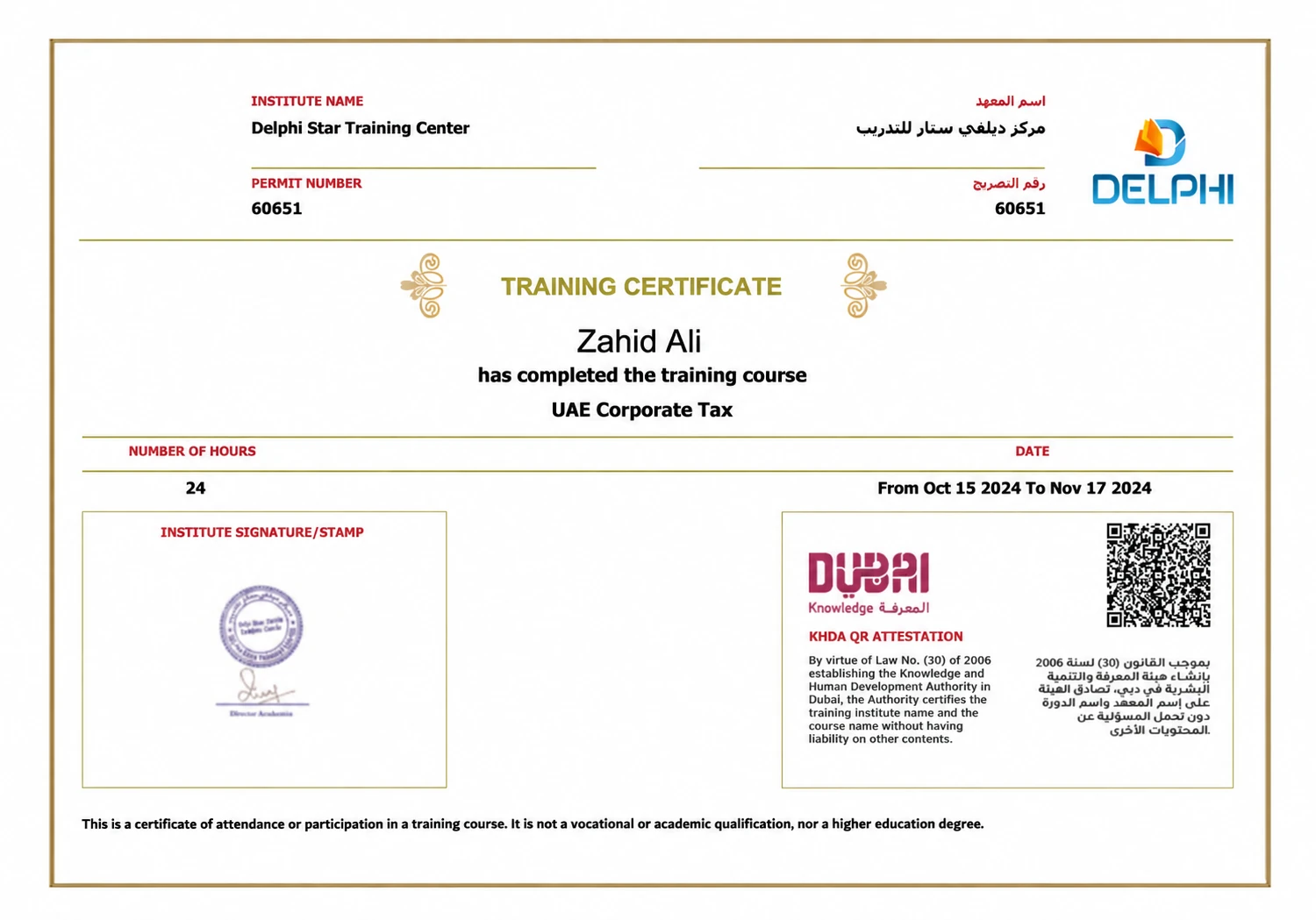
The UAE Corporate Tax course and Delphi Star Training Center are KHDA approved. Learners receive a KHDA course-completion certificate and an EduDelphi UAE Corporate Tax course-completion certificate.
These are professional training documents, not an academic degree, an FTA Tax Agent licence or authorisation to provide regulated tax advice.
What the course provides
- 18+ hours of structured UAE Corporate Tax learning.
- Current framework, computation and filing-workflow coverage.
- Practical cases, templates and capstone outputs.
- Professional-development evidence for CV, LinkedIn and employer records.
Meet Your UAE Corporate Tax Trainers

CA Shyam Sarrof
CPA (USA), CMA (USA), ACA, ACMA, CS, CFA, ACTM, MBA, B.Com (H)
22+ years of UAE tax, finance, compliance and advisory experience
Shyam supports 100+ UAE client organisations across tax, finance, controls and compliance. He connects financial statements with taxable-income computation, Free Zone reviews, related-party matters, EmaraTax workflows and filing readiness.

Avijit Goswami
CPA (USA), CMA (USA), FCS, FCMA, LLB, CFA, M.Com
Corporate Tax, Financial Reporting and Compliance Faculty
Avijit focuses on technical interpretation, trial-balance and financial-statement review, tax adjustments, reliefs, losses, Free Zone questions, related parties, documentation and filing-quality checks.
Use UAE Corporate Tax Skills in Finance, Tax and Advisory Work
Build evidence of practical learning that can be discussed in interviews, internal role changes and UAE-facing client or employer work.
Portfolio evidence
Use completed computations, QFZP checks, return maps and the capstone to explain what you practised.
Interview support
Prepare to discuss tax adjustments, Free Zone conditions, related-party issues, records and filing controls.
Career guidance
Access CV, LinkedIn, interview, role-mapping and placement-oriented support relevant to your experience.
What Learners Say About EduDelphi Training
EduDelphi’s wider training experience is rated 4.6/5 across 200+ Google reviews. Veena Shibu’s review specifically describes Corporate Tax and VAT learning.
“It’s an extensive exploration of VAT and Corporate Taxes in the UAE, covering all the major components with thoroughness and clarity. Through this course, I gained a comprehensive understanding of the intricate procedures involved in tax filing and processing.”
Veena Shibu
“Excellent Place with Top Notch Experts & Services.”
Syed Nadeem Abidi
“I am satisfied with Delphi’s training course and the fees are reasonable. Highly recommended!”
Lemuel Quider
Choose the Right UAE Corporate Tax Learning Route
| Route | Best for | What to expect |
|---|---|---|
| FTA or free self-study | Independent introductory research. | Official or free resources without personalised teaching, guided cases or feedback. |
| EduDelphi live online | Structured learning, questions and feedback. | Trainer-led sessions, actual EmaraTax demonstrations, recordings, computations and capstone work. |
| EduDelphi self-paced | Flexible study around your schedule. | Recorded learning, notes, cases, templates, practice questions and applicable support. |
| Extended diploma | A longer assessed qualification route. | More study hours, higher fee commitment and a separate assessment structure. |
| FTA Tax Agent pathway | Formal regulated registration. | Separate education, experience, examination, insurance and registration requirements. |
Should You Study UAE Corporate Tax or UAE VAT?
Choose Corporate Tax for annual taxable-income work. Choose VAT for transaction, invoice, input-tax and periodic-return work.
| Corporate Tax course | VAT course |
|---|---|
| Begins with accounting income | Begins with taxable supplies and transactions |
| Builds an annual taxable-income computation | Calculates output and recoverable input VAT |
| Covers QFZP and Free Zone income conditions | Covers Designated Zone VAT treatment |
| Includes Related Parties and transfer pricing | Includes invoices, evidence and place-of-supply rules |
| Prepares for a Corporate Tax return | Prepares for periodic VAT returns |
Corporate UAE Corporate Tax Training
Build a consistent Corporate Tax process across finance, accounting, tax, audit, compliance and management teams.
- Training-needs discussion and role mapping.
- Standard programme or customised topic emphasis.
- Approved or anonymised company cases.
- Mainland, Free Zone, group and sector-relevant scenarios.
- Computation, related-party, filing and documentation workshops.
- Private online, company, hotel or EduDelphi-premises delivery.
- Attendance reporting and management learning summaries.

UAE Corporate Tax Course Fees and Learning Options
18+ guided hours
Clear teaching, actual EmaraTax demonstrations, computations, case work and practical reinforcement.
Recordings and resources
Recordings for every live cohort plus notes, official-source links, worksheets, templates and practice questions.
Certificates
KHDA and EduDelphi UAE Corporate Tax course-completion certificates.
Fees and schedules are provided on enquiry for live online, standalone self-paced, private, one-to-one and corporate options.
UAE Corporate Tax Course in Dubai
For Dubai classroom schedules, BurJuman-area location information and UAE-local delivery, use the dedicated Dubai course page.
Online UAE Corporate Tax Course FAQs
What is included in EduDelphi’s online UAE Corporate Tax course?
The 18+ hour programme covers scope, taxable persons, rates, Small Business Relief, accounting-to-tax adjustments, QFZP rules, reliefs, transfer pricing, EmaraTax, records, FTA readiness and an integrated UAE business case.
Can I choose between live online and self-paced study?
Yes. Trainer-led online cohorts and a separate self-paced course are available. Private, one-to-one and corporate formats can also be arranged.
What is the difference between the live and self-paced routes?
Live cohorts provide scheduled teaching, questions, demonstrations, feedback and recordings. Self-paced learners work through recorded lessons and supporting resources around their own timetable.
Do live online learners receive class recordings?
Yes. Every live cohort includes recordings that can be used for revision, catch-up and repeated practice.
Can the online course accommodate different time zones?
Available schedules vary by cohort. Share your location and preferred timings in the enquiry form so the team can recommend the most suitable live, self-paced or private route.
Can I arrange individual Corporate Tax lessons?
Yes. One-to-one and private delivery are available for learners who need focused pacing, direct faculty interaction or emphasis on particular course topics.
Do I need accounting or tax experience before joining?
No formal prerequisite applies. Accounting familiarity is helpful, but the course establishes the framework first and then develops computation, Free Zone, transfer-pricing and filing skills progressively.
What work is completed during the programme?
Exercises include person classification, accounting-to-tax reconciliation, taxable-income calculations, Small Business Relief checks, QFZP analysis, Related Party review, return mapping, evidence preparation and a capstone.
Will I see the EmaraTax Corporate Tax return workflow?
Yes. The faculty use training cases to demonstrate the relevant platform flow and return fields. The class does not submit a real return belonging to a learner or employer.
What is the basic method for calculating UAE Corporate Tax?
Begin with accounting income, apply the adjustments required by the Corporate Tax framework and determine taxable income. For most taxable persons, the general rates are 0% up to AED 375,000 of taxable income and 9% above that amount.
How much time is generally allowed to file a Corporate Tax return?
The usual filing and payment period is nine months from the end of the relevant Tax Period. A 31 December 2025 year-end would ordinarily have a 30 September 2026 deadline.
Is 0% automatic for a UAE Free Zone company?
No. The entity must meet the QFZP conditions, and the 0% treatment concerns Qualifying Income. Other taxable income, registration, return and recordkeeping rules still need to be considered.
What QFZP topics are taught online?
The course addresses Qualifying Income, Excluded Activities, de minimis, substance, audited financial statements, mainland transactions, supporting records and the consequences of failing an applicable condition.
Is Small Business Relief the same as having no filing duty?
No. An eligible person makes the election through its return and remains responsible for the applicable registration, simplified-return and recordkeeping requirements.
Are sole proprietors and other natural persons discussed?
Yes. The course explains when a natural person carrying on a UAE Business or Business Activity may enter the Corporate Tax framework, including the AED 1 million annual turnover threshold and relevant exclusions.
How much transfer pricing does the programme include?
Learners cover Related Parties, Connected Persons, arm’s-length reasoning, transaction mapping, disclosure questions, owner or management payments and documentation readiness.
How is AI used during Corporate Tax training?
Controlled exercises use AI to assist source comparison, issue spotting, categorisation, reconciliation review, scenario testing and first-pass documentation. Learners must still verify the law, facts, calculations and evidence.
Which downloadable resources are included?
Resources include notes, official-source links, worksheets, QFZP and related-party files, return maps, deadline calendars, evidence checklists, practice questions and capstone materials.
What certificates are issued after completion?
Learners receive the applicable KHDA UAE Corporate Tax course-completion certificate and an EduDelphi course-completion certificate.
Is there an end-of-course examination?
No final examination is used. Understanding is developed through demonstrations, questions, calculations, cases, practical outputs and the integrated capstone.
Does this training register a learner as an FTA Tax Agent?
No. FTA Tax Agent registration is a separate regulated process with its own qualification, experience, language, training or examination, insurance and registration requirements.
Can an employer book online Corporate Tax training for a team?
Yes. Private team delivery can include role mapping, selected topic emphasis, sector-relevant cases, online workshops, attendance reporting and management learning summaries.
Where can I find the Dubai classroom option?
Classroom schedules, the BurJuman-area venue and Dubai-specific course information are available on the dedicated UAE Corporate Tax Course in Dubai page.
How do I receive current online fees and schedules?
Submit an enquiry with your preferred format and timing. EduDelphi will provide the available live, self-paced, private, one-to-one or corporate options and the corresponding fee.
Does the online course replace professional tax advice?
No. It is professional education using training scenarios. A real entity’s treatment should be assessed against current legislation, FTA guidance, its own facts and appropriately qualified advice.
Choose Your UAE Corporate Tax Learning Route
Tell us your location, preferred route and schedule. We will share current fees, the detailed syllabus and available live, self-paced, private or corporate options.